
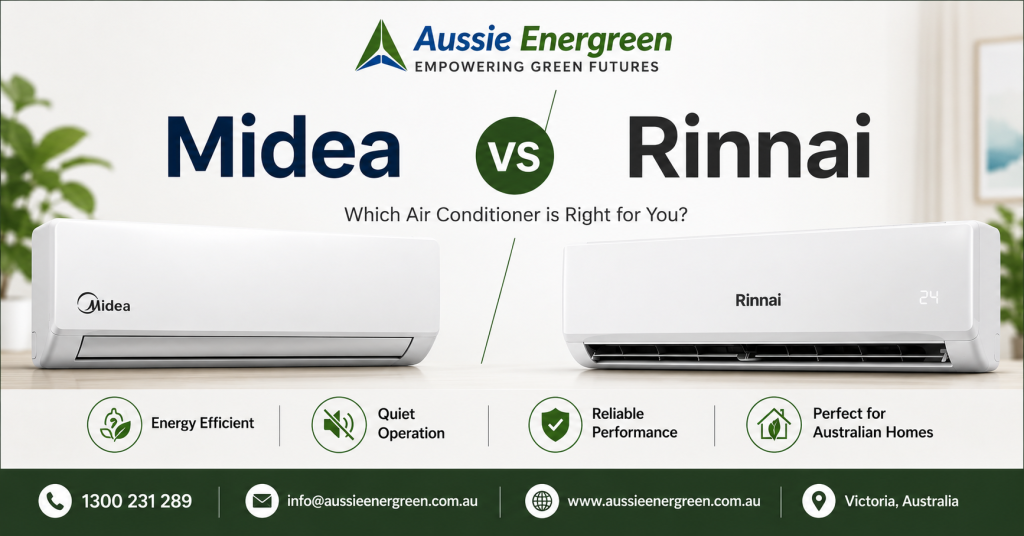
If you’re heating and cooling more than one or two rooms, a multi-split system is usually the smarter choice over installing several single split units. One outdoor unit, multiple indoor heads, independent temperature control in each room — and significantly less clutter on your exterior wall.
In Victoria, two brands dominate the multi-split conversation: Midea and Rinnai. Both are approved under the Victorian Energy Upgrades (VEU) program, both are genuinely energy-efficient, and both show up constantly in quotes homeowners get across Melbourne. So which one should you actually choose?
As a VEU-accredited provider that installs and services both brands across Melbourne, we get this question every week. Here’s an honest, practical breakdown.
What Is a Multi-Split System?
A multi-split air conditioning system connects several indoor units — typically up to five or six — to a single outdoor condenser. Instead of one outdoor unit per room, you get one outdoor unit serving your whole home, with each indoor head controlled independently. It’s ideal for:
- Homes with limited outdoor wall or ground space
- Families who want different temperatures in different rooms
- Renovators replacing old ducted gas heaters with a cleaner, all-electric setup
- Anyone wanting to avoid a row of outdoor condensers along the side of the house
Midea vs Rinnai Multi-Split Systems: The Key Differences
Energy Efficiency
This is where opinions genuinely differ depending on the specific models compared. Some efficiency comparisons show Midea’s multi-split units performing marginally better on EER and COP ratings at certain capacities, which can translate to lower running costs and stronger VEU rebate eligibility. Other real-world quotes and independent comparisons show Rinnai units outperforming Midea at the same capacity. The honest answer: efficiency varies model-to-model and capacity-to-capacity, so the specific unit configuration matters more than the brand name alone. This is exactly why a proper load calculation and system design matters more than picking a brand off a spec sheet.
Indoor Unit Styles
Rinnai offers a wider range of indoor unit types, including floor console units — useful for rooms where wall space is limited or where a wall-mounted head isn’t practical. Midea’s multi-split range is currently more focused on wall-mounted heads.
Smart Features and Wi-Fi Control
Rinnai tends to include built-in Wi-Fi control as standard across more of its range, along with smart, grid-friendly energy features on select models. Midea also offers Wi-Fi-enabled models, though on some units it may require an add-on module or central controller rather than being built in from the factory.
Installation
Midea includes a feature called Auto Piping Correction on some models, which helps installers verify and correct refrigerant piping connections during setup — reducing the chance of installation error. Rinnai doesn’t have an equivalent built-in feature, but with a qualified, experienced installer this isn’t a meaningful disadvantage. As with efficiency, correct installation — proper pipe runs, correctly flared joints, no shortcuts on refrigerant handling — affects performance and longevity far more than which brand’s logo is on the outdoor unit.
Warranty and Support
Warranty terms vary by model and are updated by both manufacturers from time to time, so it’s worth confirming current terms on the specific unit you’re quoted rather than relying on a blanket number. Rinnai has a long-established presence in the Australian market with strong local parts and service support. Midea is a newer entrant to the Australian air conditioning market but is one of the largest appliance manufacturers globally, and its local support network has grown substantially in recent years.
A word of caution that applies regardless of brand: warranty terms are only as good as the installer standing behind them. Choose a provider that will still be around — and answering the phone — in five or seven years.
Price
Both Midea and Rinnai sit in a similar mid-range price bracket — noticeably cheaper than premium brands like Daikin or Mitsubishi Electric, while still offering genuine inverter technology, reverse-cycle heating and cooling, and multi-zone control. For many Melbourne households, this is exactly the value sweet spot: strong performance and rebate eligibility, without paying a premium-brand price tag.
VEU Rebates: Where the Real Savings Are
Both Midea and Rinnai have models on the approved products list under the Victorian Energy Upgrades program, meaning eligible households can access substantial rebates on the upfront cost of a new system. The rebate amount is tied to the specific model’s efficiency rating and capacity, not the brand as a whole — so two systems with the same brand name can carry very different rebate values depending on the exact unit.
This is where a lot of homeowners lose money without realising it: choosing a slightly less efficient model, or a poorly matched combination of outdoor and indoor units, can mean a smaller rebate and higher running costs for the life of the system. Getting the sizing and model selection right from the start matters more than the brand debate.
So, Which One Should You Choose?
Honestly — neither brand is the “wrong” choice. Both Midea and Rinnai make reliable, efficient, VEU-approved multi-split systems that perform well in Melbourne conditions. The right choice comes down to:
- Your room layout — if you need a floor console option, Rinnai gives you that flexibility
- Your budget — get quotes on comparable capacity units from both brands
- Your priorities — smart features and built-in Wi-Fi, or a slightly different efficiency profile
- Your installer — correct sizing, correct installation, and genuine after-sales support matter more than brand loyalty
Midea vs Rinnai Multi-Split Systems
| Feature | Midea | Rinnai |
|---|---|---|
| Energy Efficiency | ★★★★☆ | ★★★★★ |
| Heating Performance | ★★★★☆ | ★★★★★ |
| Cooling Performance | ★★★★★ | ★★★★★ |
| Quiet Operation | ★★★★☆ | ★★★★★ |
| Smart Control | Available on selected models | Available on selected models |
| Price | More affordable | Premium investment |
| Warranty | Competitive | Excellent manufacturer warranty |
| Best For | Budget-friendly installations | Premium home comfort |
Get Expert, Unbiased Advice from Aussie Energreen
At Aussie Energreen, we’re not tied to pushing one brand over another. As a VEU-accredited provider based in Melbourne, our job is to design the right system for your home — the correct capacity, the right combination of indoor units, and the model that maximises your rebate eligibility — whether that ends up being Midea, Rinnai, or another approved brand entirely.
We’re specialists in air conditioning, heat pump hot water systems, solar panels, and solar battery installation, so we can also help you look at the bigger picture: how a new air conditioning system fits alongside solar and battery storage to bring your running costs down even further.
FAQs Midea vs Rinnai Multi-Split Systems
1. What’s the main difference between Midea and Rinnai multi-split systems? Both are efficient, VEU-approved multi-split systems in a similar price bracket. The main practical differences are indoor unit styles (Rinnai offers floor console options; Midea is wall-mount focused), how Wi-Fi control is delivered, and model-specific efficiency ratings — the exact unit matters more than the brand overall.
2. Which brand offers a bigger VEU rebate? It depends on the specific model and its efficiency rating, not the brand as a whole. A correctly sized, higher-efficiency unit from either brand can generate a stronger rebate than a mismatched or oversized system from the other.
3. Can I install a floor console unit with a Midea multi-split system? Currently, Midea’s multi-split range is focused on wall-mounted indoor units. If you need a floor console for a specific room, Rinnai offers that option.
4. Is Midea a reliable brand, given it’s newer to the Australian market? Midea is one of the largest appliance manufacturers in the world, and its local presence and support network in Australia has expanded significantly. Reliability comes down to the specific unit and, just as importantly, correct installation and servicing.
5. How long is the warranty on Midea and Rinnai multi-split systems? Warranty terms vary by model and are updated periodically by both manufacturers, so it’s best to confirm the current warranty on the exact unit you’re quoted. We’ll always give you accurate, up-to-date warranty information for the specific system we recommend.
6. Do I need a different size outdoor unit depending on how many rooms I’m cooling? Yes. Outdoor unit capacity needs to be matched to the combined load of all connected indoor units and your home’s insulation, orientation, and room sizes. We do a proper assessment before recommending a system, rather than sizing off a rule of thumb.
7. Can Aussie Energreen help with rebates for solar and heat pumps too, or just air conditioning? We’re VEU-accredited across air conditioning, heat pump hot water, solar panels, and solar battery installation, so we can help you access rebates and design an efficient system across your whole home — not just one appliance at a time.
8. How do I get started? Get in touch with our team for a free assessment. We’ll look at your home, recommend the right multi-split configuration, confirm your VEU rebate eligibility, and handle the full installation with licensed, experienced technicians.