
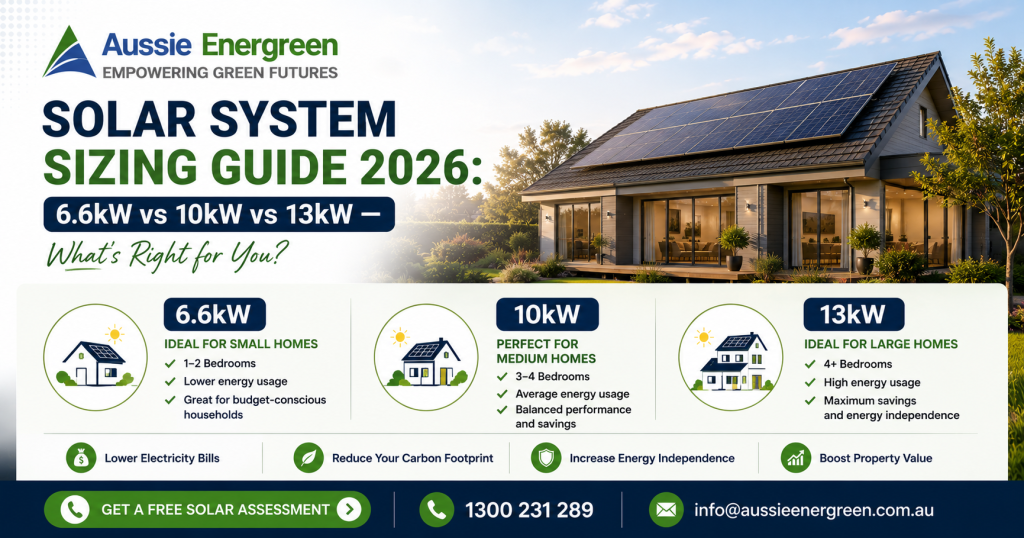
Choosing the right solar system size is one of the most important decisions when investing in solar energy. The size you select can influence your upfront investment, electricity savings, payback period and ability to meet future energy needs.
A system that is too small may leave you relying on grid electricity, particularly during winter or periods of high household consumption. On the other hand, installing a system that is larger than necessary may increase your initial investment without providing the expected benefits.
In 2026, 6.6kW, 10kW and 13kW systems are popular options for Australian households. But which one is right for your home?
At Aussie Energreen, we help Melbourne homeowners choose solar systems based on their electricity usage, property, future energy plans and available roof space.
Solar System Sizing: Where Should You Start?
Before deciding between a 6.6kW, 10kW or 13kW system, it’s important to understand how much electricity your household actually uses.
A simple starting point is:
Solar System Size (kW) = Average Daily Energy Usage × 1.25 ÷ Peak Sun Hours
The 1.25 factor provides an allowance for common system losses, including inverter conversion, wiring, temperature effects and other performance factors.
Your average daily usage
Look at your electricity bills from the previous 12 months rather than relying on just one bill. Household consumption can change significantly throughout the year due to heating, cooling and other appliances.
Peak sun hours
Solar generation also depends on where you live. Melbourne generally receives fewer peak sun hours than many parts of Australia, which means system sizing needs to account for local conditions.
Don’t forget future energy usage
Your current electricity consumption isn’t the only consideration. Think about whether you plan to add:
- An electric vehicle
- A heat pump hot water system
- A swimming pool
- Ducted air conditioning
- Additional electrical appliances
- A home battery
Planning ahead can prevent you from needing to expand your solar system sooner than expected.
Solar System Guide: 6.6kW vs 10kW vs 13kW
Each system size can suit a different type of household.
| System Size | Approx. 440W Panels | Typical Use | Best Suited For |
|---|---|---|---|
| 6.6kW | Around 15 panels | Lower to moderate energy use | Small to medium households |
| 10kW | Around 23 panels | Moderate to high energy use | Larger families and high-energy homes |
| 13kW | Around 30 panels | High energy consumption | Large homes, EVs and battery systems |
Actual panel numbers depend on the panel wattage selected, while generation varies according to location, orientation, shading and weather.
Is a 6.6kW Solar System Right for You?
A 6.6kW solar system remains a popular choice for Australian homes because it can provide a good balance between system size, installation cost and energy generation.
It can be suitable for smaller households with moderate electricity consumption and homes without significant future energy loads.
A 6.6kW system may suit you if:
- You have a small or medium-sized home
- Your electricity consumption is relatively moderate
- You have limited roof space
- You want to keep the initial investment lower
- You don’t currently have an EV or large electrical loads
If you’re planning to purchase an EV or install a battery in the near future, however, it may be worth comparing a larger system.
Why Consider a 10kW Solar System?
A 10kW solar system provides additional generation capacity and can be a good fit for households with higher electricity consumption.
It’s particularly worth considering if your home uses ducted air conditioning, pool equipment or several major electrical appliances.
A 10kW system may be suitable for:
- Larger families
- Homes with higher electricity consumption
- Properties with ducted air conditioning
- Homes with swimming pools
- Households planning to install a battery
- Homes preparing for an EV
The additional solar generation can provide more daytime electricity and potentially create more surplus energy for battery storage.
When Does a 13kW Solar System Make Sense?
A 13kW system, often configured with around 13.2–13.3kW of panels depending on the panel selection, can be suitable for households with substantial electricity requirements.
This size may be particularly attractive for homeowners combining multiple electrical technologies.
For example, a home with:
- An electric vehicle
- Heat pump hot water
- Large air conditioning requirements
- A home battery
- High daily electricity consumption
may benefit from having greater solar generation capacity.
A larger system can also provide additional generation during periods when solar production is reduced, although actual output depends heavily on location and system design.
How an EV Can Change Your Solar Requirements
An electric vehicle can significantly increase household electricity consumption.
Depending on the vehicle, driving distance and charging habits, an EV can add several kilowatt-hours of electricity consumption per day.
If you’re planning to purchase an EV, it’s worth considering this additional demand before choosing your solar system.
For some households, moving from 6.6kW to 10kW or larger may provide more solar generation to support EV charging.
What About Heat Pump Hot Water?
Heat pump hot water systems are highly efficient, but they still add electricity demand to your home.
Because a heat pump can often operate during daylight hours, it can work particularly well alongside solar panels.
A correctly designed solar system can help power the heat pump using electricity generated from your rooftop rather than relying entirely on grid electricity.
If you’re planning both solar and a heat pump, consider the combined energy requirements when selecting your system size.
Should You Choose a Larger System If You Want a Battery?
If you’re considering a battery, your solar system size becomes even more important.
A larger solar array can generate additional electricity during the day, providing more opportunity to:
- Power your home directly.
- Charge your battery.
- Export surplus electricity to the grid.
However, battery sizing should also be based on your actual electricity consumption and solar generation.
The best combination isn’t necessarily the largest solar system and largest battery. A properly matched system can provide better overall value.
Don’t Forget About Your Roof
Your available roof space can affect which system size is practical.
For example, approximately 15 panels at 440W would be needed for a 6.6kW system, while a 13kW system could require around 30 panels.
Before selecting a system, an installer should assess:
- Available roof area
- Roof orientation
- Roof pitch
- Shading
- Panel layout
- Existing solar panels
- Roof condition
East- and west-facing panels can also be useful because they can spread solar generation across more hours of the day.
Understanding Solar Export Limits
A larger solar system doesn’t necessarily mean you can export all of the generated electricity to the grid.
Your permitted export capacity can depend on your distribution network, property connection and whether your home has single-phase or three-phase power.
This is particularly important when considering larger systems such as 10kW and 13kW.
Even where export limits apply, additional solar generation can still potentially be useful because your home can consume the electricity directly or a compatible battery can store it.
Your installer should check the relevant requirements for your property before finalising the system design.
A Simple Way to Choose Your Solar System Size
Use this process when comparing your options:
Step 1: Review Your Electricity Bills
Look at your previous 12 months of electricity consumption.
Step 2: Calculate Average Daily Usage
Add your annual electricity consumption and divide it by the number of days.
Step 3: Consider Your Location
Solar generation varies depending on where you live, so local conditions should be included in the system design.
Step 4: Add Future Energy Loads
Consider EV charging, heat pump hot water, batteries, pools and additional appliances.
Step 5: Check Your Roof
Make sure there is enough suitable roof space for the number of panels required.
Step 6: Check Your Grid Connection
Your installer should confirm applicable export and connection requirements.
Step 7: Compare System Options
Compare 6.6kW, 10kW and 13kW systems based on your actual energy requirements rather than simply choosing the cheapest option.
Which Solar System Size Is Best?
There is no universal answer because every home is different.
6.6kW
A practical option for smaller households with moderate energy consumption and limited future electrical loads.
10kW
A strong option for larger households and homes with higher electricity consumption, air conditioning, pools or future battery plans.
13kW
Worth considering for high-energy households with EVs, batteries, heat pumps and multiple major electrical loads.
The right choice depends on how much electricity you use today and how much you expect to use in the future.
Why Choose Aussie Energreen?
At Aussie Energreen, we help Melbourne homeowners design solar systems around their actual energy requirements.
Our team can help you with:
- Solar system sizing
- Solar panel installation
- Solar battery storage
- Hybrid inverters
- Energy assessments
- EV-ready solar solutions
- Heat pump integration
- System design
- Professional installation
- Solar monitoring
We don’t believe in a one-size-fits-all approach. Our goal is to help you choose a system that works for your home, electricity consumption and future plans.
FAQs About Solar System Guide: 6.6kW vs 10kW vs 13kW
Is 6.6kW enough for a Melbourne home?
A 6.6kW system can be suitable for many small to medium households with moderate electricity consumption. However, homes with high energy use or future plans for an EV or battery may benefit from considering a larger system.
How many panels are needed for a 10kW solar system?
With 440W panels, approximately 23 panels would be required to provide around 10kW of panel capacity. The exact number depends on the panel wattage selected.
Is a 13kW solar system too large for a home?
Not necessarily. A 13kW system can make sense for homes with high electricity consumption, EV charging, heat pumps, batteries or multiple major electrical loads. The available roof space and grid connection also need to be considered.
Should I install a bigger solar system if I plan to buy an EV?
It can be beneficial to account for your future EV charging requirements when sizing your solar system. If you expect electricity consumption to increase substantially, comparing a 10kW or larger system may be worthwhile.
Does roof orientation affect solar system sizing?
Yes. Roof orientation, pitch, shading and panel placement all influence solar generation. A professional site assessment can determine the most effective panel layout for your property.
Can I add more solar panels later?
Additional panels may be possible, but this depends on your existing inverter, roof space, electrical setup and applicable connection requirements. Planning for future energy needs upfront can sometimes be more practical.
Does a larger solar system always mean bigger savings?
No. The system should be appropriately sized for your electricity consumption and energy goals. A larger system can generate more electricity, but its value depends on how much of that energy your household can use or store.
Summary: Solar System Guide: 6.6kW vs 10kW vs 13kW
Choosing your solar system size should be based on more than today’s electricity bill.
6.6kW can be a practical choice for smaller households with moderate energy consumption.
10kW can provide additional generation for larger families and homes with higher electricity demand.
13kW can be worth considering for high-energy households using or planning EVs, batteries, heat pumps and other major electrical appliances.
The most important step is to assess your current electricity usage, future energy plans, roof space, solar potential and local grid requirements before making a decision.
Ready to find the right solar system for your Melbourne home?
Aussie Energreen can assess your energy requirements and help you compare the right solar system size for your property.
📞 1300 231 289
📧 info@aussieenergreen.com.au
🌐 aussieenergreen.com.au
📍 Melbourne, Victoria
Get the right system size. Generate more of your own power. Take control of your energy with Aussie Energreen.