
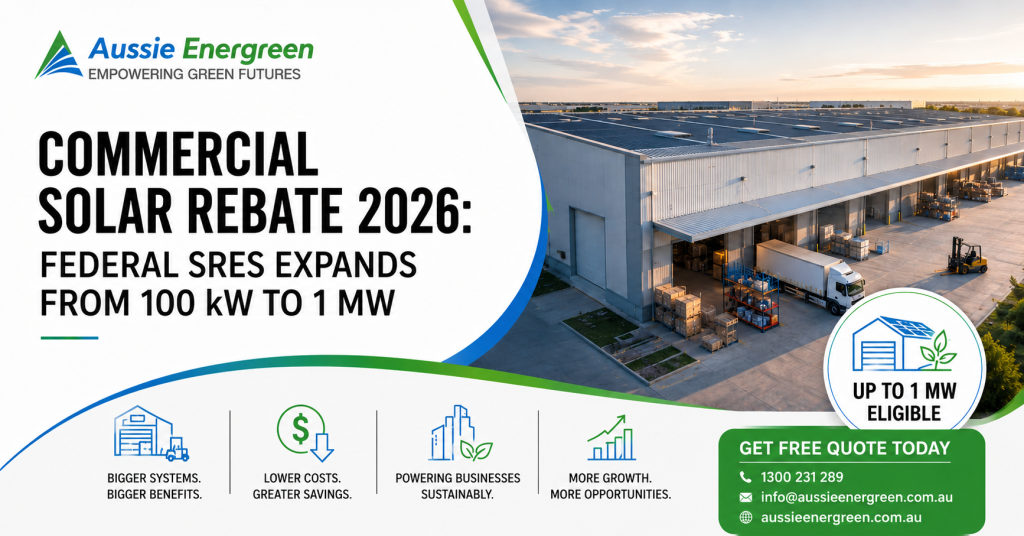
Australian businesses could soon have a much bigger opportunity to reduce the upfront cost of commercial solar.
The Federal Government has announced an expansion of the Small-scale Renewable Energy Scheme (SRES), increasing the eligible solar system size from 100 kW to 1 MW.
The change, announced on 5 August 2026, is expected to make medium-sized commercial solar systems significantly more affordable, with the Government estimating savings of around 20% on the installation cost for eligible systems.
The expanded support is expected to begin from 1 October 2026, subject to the required regulations being finalised.
For businesses with large warehouses, factories, retail facilities, farms, schools and other commercial properties, this could make 2026 an important year to consider solar.
Commercial Solar Rebate 2026 at a Glance
| Key Detail | What It Means |
|---|---|
| Scheme | Small-scale Renewable Energy Scheme (SRES) |
| Previous system limit | 100 kW |
| New proposed limit | Up to 1 MW |
| Potential saving | Around 20% for eligible mid-sized systems |
| Expected commencement | 1 October 2026* |
| Rebate mechanism | Small-scale Technology Certificates (STCs) |
| Administered by | Clean Energy Regulator |
| Announcement | 5 August 2026 |
*The expanded eligibility is subject to the necessary regulations being finalised.
What Is Changing With the Commercial Solar Rebate?
The SRES has been supporting renewable energy installations across Australia since 2011.
Under the existing rules, eligible solar systems up to 100 kW can receive an upfront benefit through Small-scale Technology Certificates, commonly known as STCs.
Systems above the 100 kW threshold have historically been treated differently, with larger commercial installations generally relying on the Large-scale Renewable Energy Target and Large-scale Generation Certificates (LGCs).
The proposed SRES expansion changes this for commercial systems between 100 kW and 1 MW.
Once the new rules commence, eligible systems within this range will be able to access STCs, providing an upfront incentive that can be reflected in the installation price.
For businesses considering a 200 kW, 300 kW, 500 kW or larger commercial solar system, this could significantly improve the upfront economics of the project.
Who Could Benefit From the Expanded SRES?
The expansion is particularly relevant to businesses that have previously fallen into the gap between residential-scale solar and larger utility-scale projects.
Potential beneficiaries include:
- Warehouses and distribution centres
- Manufacturing facilities
- Farms and agricultural businesses
- Retail businesses
- Shopping centres
- Schools and education facilities
- Healthcare facilities
- Logistics and transport businesses
- Community organisations
- Commercial and industrial properties
If your business has a large roof and substantial daytime electricity consumption, a commercial solar system could help reduce your dependence on grid electricity while improving long-term energy costs.
Why Is the 1 MW Limit Significant?
Increasing the SRES threshold from 100 kW to 1 MW is a substantial change.
A 100 kW system may contain roughly a few hundred modern solar panels, depending on the panel size and system design.
A 1 MW commercial system can require several thousand panels and is more suited to large warehouses, factories, distribution centres and other high-energy-use facilities.
This means many businesses that previously had limited access to upfront federal solar incentives could potentially benefit from the expanded scheme.
The “Missing Middle” of Commercial Solar
The 100 kW limit created a significant gap for businesses.
A company requiring a 300 kW or 500 kW solar system could not receive the same upfront STC treatment available to smaller systems.
The proposed expansion is designed to address this gap by bringing systems up to 1 MW into the SRES framework.
How Much Could the Commercial Solar Rebate Save?
The Federal Government has indicated that the expanded SRES could reduce the installation cost of a medium-sized commercial solar system by around 20%.
However, there is no single fixed rebate amount for every business.
The actual STC value depends on several factors, including:
- Solar system capacity
- Location and applicable solar zone
- Remaining deeming period
- STC market value
- Installation and eligibility requirements
For example, if a commercial solar project had an indicative installation cost of $300,000, a 20% reduction would represent approximately $60,000.
A $550,000 project with a similar 20% reduction would represent approximately $110,000.
These figures are illustrative only and should not be treated as fixed rebate amounts or installation quotes. Your actual incentive will depend on the final scheme rules and project details.
How Do STCs Work?
Small-scale Technology Certificates are designed to provide an upfront financial incentive for eligible renewable energy installations.
The basic calculation considers:
STCs = System Capacity × Zone Rating × Deeming Years
The resulting certificates have a market value, which can be applied as an upfront discount.
In most cases, businesses do not need to manage the certificates themselves.
An eligible installer can typically arrange the STC process on the customer’s behalf, with the certificate value reflected in the project quotation.
This makes the process considerably simpler for businesses looking to install commercial solar.
Why the Timing Matters for Businesses
The expanded SRES is expected to commence from 1 October 2026, subject to the required regulations.
However, businesses planning a commercial solar installation should not necessarily wait until October to start planning.
Large commercial projects can require considerable preparation, including:
- Energy usage analysis
- Solar system design
- Roof assessment
- Engineering
- Network connection approval
- Equipment selection
- Installation planning
- Project approvals and documentation
Starting the planning process early can help your business understand the potential costs and savings before the new incentive becomes available.
Commercial Solar Can Deliver More Than a Rebate
While the potential upfront incentive is significant, the long-term benefits of commercial solar should also be considered.
Reduce Electricity Costs
Commercial businesses often use significant amounts of electricity during daylight hours.
Solar generation during business hours can help offset electricity purchased from the grid, potentially reducing ongoing energy costs.
Improve Energy Independence
Generating electricity on-site can reduce your business’s reliance on the electricity grid.
For businesses with large energy requirements, this can provide greater control over long-term energy expenses.
Make Better Use of Large Roofs
Warehouses, factories and commercial buildings often have substantial roof space.
Installing solar can turn previously unused roof space into an energy-generating asset.
Support Sustainability Goals
Commercial solar can help businesses reduce their reliance on conventional grid electricity and work towards broader sustainability and emissions-reduction goals.
Potentially Improve Payback
A lower upfront installation cost can improve the overall financial case for a solar investment.
However, payback will depend on factors such as system size, electricity consumption, energy prices, installation costs and the final incentive available.
What Businesses Should Do Now
If you are considering a 100 kW to 1 MW commercial solar system, now is a good time to start assessing your options.
1. Review Your Electricity Usage
Look at your electricity bills and, where available, your interval consumption data.
Understanding when your business uses the most electricity will help determine the appropriate solar system size.
2. Assess Your Roof
A professional assessment can determine whether your roof has enough suitable space for the required solar capacity.
Roof condition, orientation, shading and structural considerations should all be reviewed.
3. Check Your Grid Connection Requirements
Larger commercial solar systems may require additional network approvals.
Understanding your local Distribution Network Service Provider (DNSP) requirements early can help avoid unnecessary project delays.
4. Compare Commercial Solar Solutions
Don’t choose a system based only on the advertised rebate.
Compare the system design, equipment, warranties, installation standards, expected energy generation and overall project cost.
5. Work With an Accredited Installer
Eligibility for government incentives can depend on meeting specific installation, product and accreditation requirements.
Working with an appropriately accredited solar provider can help ensure your project is designed and installed according to the relevant requirements.
Why Choose Aussie Energreen for Commercial Solar?
At Aussie Energreen, we help Australian businesses explore practical energy solutions designed around their individual electricity requirements.
Our commercial solar approach focuses on more than simply installing panels.
We can help businesses understand:
- Suitable solar system sizes
- Energy consumption patterns
- Potential upfront incentives
- Solar generation opportunities
- Installation requirements
- Equipment options
- Long-term energy savings
- Commercial project planning
Whether you operate a warehouse, factory, retail business, farm or commercial facility, our team can help you assess whether solar is the right investment for your property.
Is the Commercial Solar Rebate Available Yet?
The expanded SRES eligibility for systems between 100 kW and 1 MW is expected to commence from 1 October 2026, subject to the required regulations being finalised.
The details of the scheme should be confirmed before making financial decisions based on the proposed incentive.
Businesses should also remember that the value of STCs can change, and eligibility depends on the final rules and individual project circumstances.
Frequently Asked Questions
When is the expanded commercial solar rebate expected to start?
The expanded SRES eligibility is expected to commence on 1 October 2026, subject to the necessary regulations being finalised.
What size commercial solar systems will be eligible?
The proposed expansion increases the SRES system-size limit from 100 kW to 1 MW. Systems below 100 kW are already covered under existing SRES arrangements, subject to eligibility requirements.
How much is the commercial solar rebate worth?
The Government has indicated that the expansion could reduce the cost of installing a medium-sized commercial solar system by around 20%. The actual value will vary depending on the system and applicable STC conditions.
Do I receive the rebate as cash?
The benefit generally works through Small-scale Technology Certificates (STCs). Where applicable, the STC value is commonly assigned to the installer and reflected as an upfront discount on the installation price.
Can warehouses benefit from the expanded rebate?
Potentially, yes. Warehouses and distribution centres are among the types of large commercial properties that could benefit from access to the expanded SRES, provided the project meets the final eligibility requirements.
Should my business wait until October 2026?
Not necessarily. Commercial solar projects can require design, engineering, network approval and installation planning. Starting the assessment early can help your business prepare for the expected commencement of the expanded incentive.
Ready to Explore Commercial Solar for Your Business?
The proposed expansion of the SRES could make 100 kW to 1 MW commercial solar systems more accessible to Australian businesses.
If your warehouse, factory, farm, retail property or commercial facility has high electricity consumption, now is the time to understand your solar potential.
Talk to Aussie Energreen about your commercial solar project and discover the right solution for your business.
Get Your Free Commercial Solar Quote Today
📞 1300 231 289
📧 info@aussieenergreen.com.au
🌐 aussieenergreen.com.au
Information correct as at August 2026. The proposed SRES expansion and its commencement are subject to final regulations and eligibility requirements. Incentive values and eligibility may vary by project.