
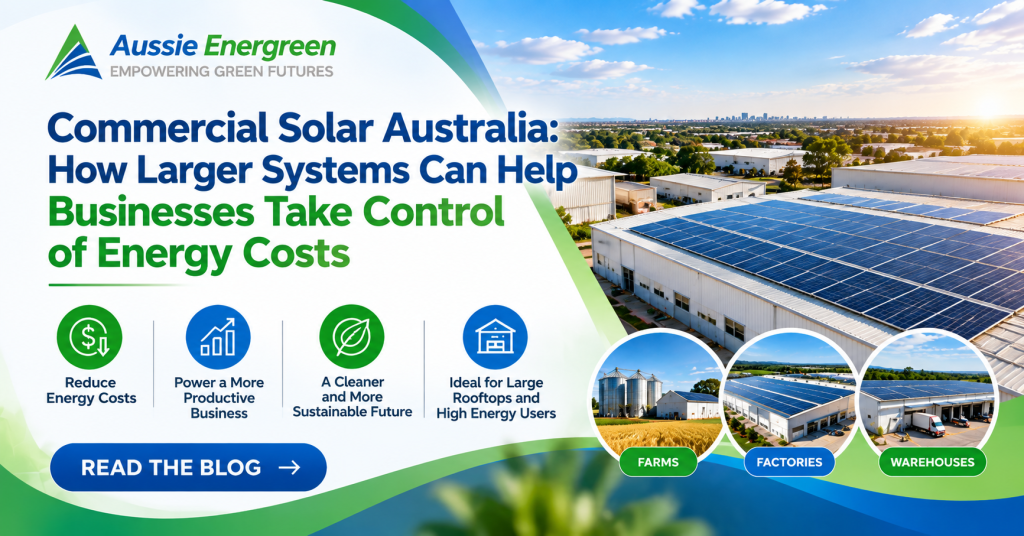
For many Australian businesses, electricity is a major ongoing operating expense. Warehouses, factories, farms, retail properties and other high-energy businesses can use substantial amounts of electricity every day for lighting, machinery, refrigeration, heating, cooling and other operations.
As electricity costs and energy demands continue to influence business planning, commercial solar can provide an opportunity to generate electricity on-site and reduce reliance on grid power.
For businesses with large rooftops or high electricity consumption, a larger commercial solar system can potentially provide more meaningful energy generation than a small installation.
In this guide, we explore how larger solar systems can support Australian businesses, what to consider before installation and how solar can become part of a broader energy strategy.
What Is Commercial Solar?
Commercial solar is a solar power system designed to meet the energy requirements of a business or commercial property.
Instead of relying entirely on electricity purchased from the grid, solar panels installed on a suitable rooftop or site generate electricity from sunlight.
The electricity generated can be used to power business operations during periods of solar production.
A typical commercial solar system includes:
- Solar panels
- Solar inverters
- Mounting equipment
- Electrical protection and connections
- Monitoring equipment
- Optional battery storage
The size and configuration of the system depend on the property’s electricity consumption, available roof space, electrical infrastructure and other site-specific factors.
Why Are Larger Solar Systems Becoming More Relevant?
A business with significant electricity consumption may have enough suitable roof space to support a much larger solar installation.
A small solar system may only cover a portion of a property’s electricity requirements, while a larger system can potentially generate considerably more electricity during suitable solar conditions.
For businesses with large energy loads, this can make better use of available rooftop space.
However, bigger does not automatically mean better. The appropriate system size should be determined by factors such as electricity consumption, roof capacity, network requirements, budget and the business’s energy goals.
How Can Commercial Solar Help Control Energy Costs?
One of the biggest reasons businesses consider solar is to reduce their reliance on electricity purchased from the grid.
When a business generates and uses solar electricity on-site, it can potentially reduce the amount of electricity it needs to purchase from the grid during solar-generation periods.
The potential benefits depend on the property’s energy consumption, solar production, electricity tariff, system size and operating patterns.
1. Generate Electricity On-Site
Solar panels allow a business to generate electricity at its own premises.
For businesses operating during daylight hours, this can be particularly relevant because electricity demand may occur at the same time as solar generation.
2. Reduce Grid Electricity Consumption
When solar generation is available, the electricity can be used by equipment operating within the property.
This may reduce the amount of electricity required from the grid at those times.
3. Make Better Use of Large Roofs
Warehouses, factories and agricultural buildings can have substantial roof areas.
Instead of leaving suitable roof space unused, businesses may be able to install solar panels and turn part of that space into an electricity-generating asset.
4. Improve Energy Cost Planning
Solar can help businesses generate a portion of their own electricity rather than relying entirely on grid supply.
While electricity prices and savings vary, generating energy on-site can form part of a longer-term strategy for managing operating costs.
Which Businesses Can Benefit From Larger Solar Systems?
Larger commercial solar systems can be relevant to a wide range of Australian businesses.
Farms and Agricultural Businesses
Farms can have large buildings, sheds and other structures with suitable roof space.
Electricity may be required for:
- Irrigation equipment
- Water pumps
- Refrigeration
- Ventilation
- Processing equipment
- Lighting
- Workshops
- Farm machinery
A properly designed solar system can help agricultural businesses generate electricity on-site for suitable electrical loads.
Factories and Manufacturing Facilities
Manufacturing facilities can have substantial electricity requirements.
Machinery, production lines, compressors, ventilation, lighting and cooling systems can all contribute to significant electricity consumption.
For businesses operating equipment throughout the day, commercial solar can help generate electricity during operating hours.
Warehouses and Distribution Centres
Large warehouses often have extensive roof areas that can be suitable for solar installations.
Energy may be used for:
- Lighting
- Refrigeration
- HVAC systems
- Material-handling equipment
- Office facilities
- Charging equipment
Solar can help businesses make productive use of available rooftop space while supporting their energy strategy.
Retail and Commercial Properties
Shopping centres, retail facilities, offices and other commercial properties can also consider rooftop solar.
Electricity may be consumed by lighting, air conditioning, refrigeration, computers and other equipment.
The suitability of solar depends on the building, energy profile and available installation area.
How Large Should a Commercial Solar System Be?
There is no universal solar system size that works for every business.
A system should be designed around the property’s actual electricity requirements rather than simply installing as many panels as possible.
Several factors should be assessed.
Electricity Consumption
Review your historical electricity bills to understand:
- Total electricity consumption
- Peak demand
- Daytime usage
- Seasonal variations
- Operating hours
This information can help determine how much solar generation could be useful.
Available Roof Space
The amount of suitable roof area can influence the maximum practical solar installation.
Roof structure, orientation, shading, access and condition should also be assessed.
Electrical Infrastructure
Larger solar systems may require additional consideration of the property’s electrical infrastructure and network connection.
A professional assessment can determine what upgrades or approvals may be required.
Future Energy Demand
Your business may expand or introduce new equipment in the future.
Potential changes such as additional machinery, refrigeration, EV charging, heat pumps or expanded operations can influence the appropriate system design.
Understanding the 1MW Opportunity
The expansion of eligibility for larger solar systems under the Small-scale Renewable Energy Scheme can create new opportunities for businesses considering larger rooftop installations, subject to the applicable eligibility requirements.
Moving beyond the previous 100kW threshold can be particularly relevant for businesses with substantial energy demand and suitable roof space.
For these businesses, the ability to consider larger systems may provide greater flexibility when matching solar generation with the property’s energy requirements.
However, businesses should confirm the current scheme rules, eligibility criteria and applicable installation requirements before making a project decision.
Can a Business Use All the Solar It Generates?
Not necessarily.
The amount of solar electricity a business can use directly depends on its electricity consumption and operating patterns.
For example, a warehouse that operates mainly during daylight hours may be able to use a significant portion of its solar generation directly.
Another business with lower daytime electricity consumption may generate more solar electricity than it needs at certain times.
Surplus electricity may potentially be exported to the grid, subject to the property’s network connection and electricity arrangements.
What About Solar Batteries?
Battery storage can complement a commercial solar system by providing another way to manage electricity generated during the day.
A battery can store suitable surplus solar energy and make that stored electricity available later, depending on the system configuration.
This may be useful for businesses that:
- Have significant evening energy demand
- Generate more solar than they can immediately consume
- Want greater control over energy usage
- Are considering broader energy-management strategies
However, batteries are not automatically the right choice for every business. A financial and technical assessment should consider the business’s electricity profile and the proposed system.
Commercial Solar and Energy Management
Solar works best when it is considered as part of a wider energy strategy.
Businesses can potentially combine commercial solar with other technologies such as:
- Battery storage
- LED lighting
- Energy-efficient air conditioning
- Heat pump hot water systems
- EV charging
- Smart energy monitoring
- Energy management systems
For example, upgrading inefficient lighting before or alongside solar installation can reduce electricity consumption, while solar can then help supply part of the remaining demand.
Benefits of Installing Commercial Solar
A well-designed commercial solar system may provide several advantages.
Potentially Lower Electricity Costs
Generating electricity on-site can reduce reliance on grid electricity during solar production periods.
Better Use of Available Roof Space
Large commercial rooftops can provide valuable space for solar generation.
Greater Energy Independence
Generating some electricity on-site can reduce a business’s dependence on external electricity supply.
Support for Sustainability Goals
Solar can help businesses increase their use of renewable electricity and support environmental objectives.
Long-Term Energy Planning
Solar can form part of a longer-term strategy for managing energy consumption and operating costs.
What Should Businesses Check Before Installing Solar?
Before committing to a commercial solar project, businesses should assess more than just the number of panels they can fit on a roof.
Important considerations include:
- Historical electricity consumption
- Electricity tariffs
- Business operating hours
- Roof condition
- Available roof area
- Structural capacity
- Shading
- Electrical infrastructure
- Network requirements
- Solar system size
- Battery requirements
- Future energy demand
- Installation and maintenance requirements
- Applicable rebates or incentives
A professional site assessment can help identify the most appropriate approach.
Is a Larger Solar System Always Better?
Not necessarily.
The goal should be to install a system that makes sense for the property’s energy profile and available infrastructure.
An oversized system may produce more electricity than the business can use at certain times, while a system that is too small may fail to take advantage of available roof space and energy demand.
The right balance depends on:
Solar generation + energy consumption + roof space + network requirements + future energy needs
This is why commercial solar should be professionally designed rather than based solely on the maximum number of panels that can fit on a roof.
Why Choose Aussie Energreen? Commercial Solar Australia
At Aussie Energreen, we help Australian businesses explore practical solar and energy-efficiency solutions.
Our solutions include:
- Commercial solar systems
- Solar battery storage
- Solar panels
- Commercial LED lighting
- Energy-efficient air conditioning
- Heat pump hot water systems
- EV charging solutions
- Broader electrification solutions
We understand that every business has different electricity requirements. A warehouse, farm and manufacturing facility may all have very different operating patterns and energy loads.
Our approach focuses on understanding your property and energy requirements before recommending a suitable solution.
Final Thoughts Commercial Solar Australia
For Australian businesses with substantial electricity consumption, larger commercial solar systems can provide an opportunity to generate more electricity on-site and make better use of available rooftop space.
Farmers, factories, warehouses and other high-energy businesses may benefit from assessing whether a larger solar system aligns with their electricity consumption and long-term energy plans.
With the evolving incentives available for eligible systems, now can be a good time for businesses to investigate their options and understand what system size may work for their property.
Commercial solar isn’t simply about installing more panels. It is about designing an energy system that works with your business, your electricity usage and your future plans.
Frequently Asked Questions Commercial Solar Australia
Can Australian businesses install large commercial solar systems?
Eligible businesses may be able to install larger solar systems, subject to applicable scheme rules, network requirements, site conditions and other regulatory considerations.
What businesses are suitable for larger solar systems?
Farms, factories, warehouses, manufacturing facilities, retail properties and other businesses with suitable energy demand and available installation space may benefit from assessing larger commercial solar options.
Is a 1MW solar system suitable for every business?
No. A 1MW system is a substantial installation and may not be appropriate for every property. System size should be based on electricity consumption, roof space, electrical infrastructure, network requirements and future energy needs.
Can commercial solar reduce electricity bills?
Solar can potentially reduce the amount of grid electricity a business purchases during periods when solar generation is available. Actual savings depend on system size, energy consumption, tariffs, solar production and other factors.
Can excess commercial solar electricity be exported?
Potentially, yes. Export arrangements depend on the property’s electricity network connection, retailer and applicable requirements.
Should businesses install a battery with commercial solar?
A battery may be beneficial for some businesses, particularly those with significant energy demand outside solar-generation hours. A technical and financial assessment can help determine whether battery storage makes sense.
How do I determine the right solar system size for my business?
Start by reviewing electricity bills, operating hours, daytime consumption, available roof space and future energy requirements. A professional assessment can then help determine a suitable system size.
Contact Aussie Energreen Commercial Solar Australia
Ready to explore commercial solar for your business?
Aussie Energreen can help you assess your solar and energy-efficiency options.
📞 1300 231 289
📧 info@aussieenergreen.com.au
🌐 www.aussieenergreen.com.au
Aussie Energreen – Empowering Green Futures