
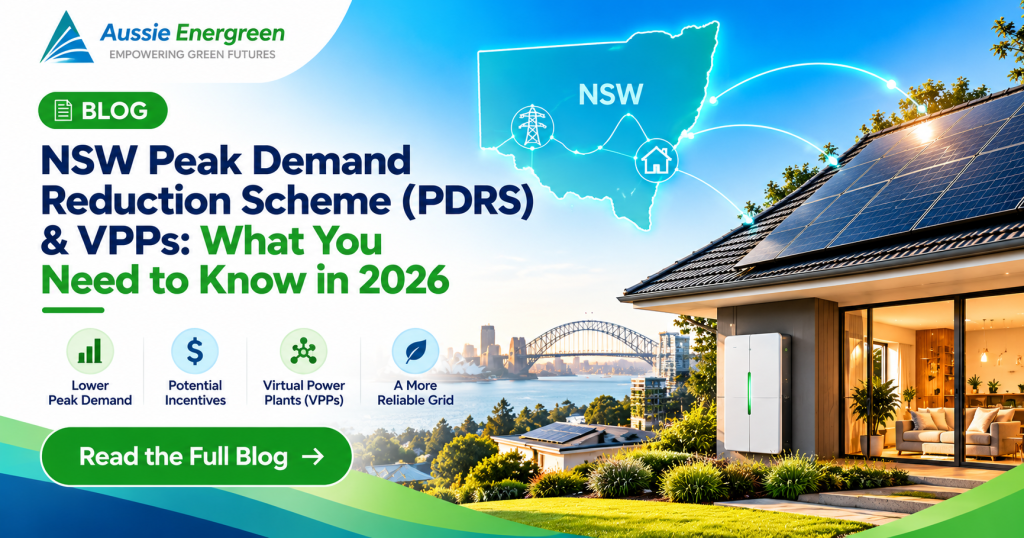
Installing a solar battery in New South Wales can help households and businesses make better use of solar energy, manage electricity consumption and explore available government incentives. However, understanding the different battery programs can be confusing, especially when advertisements mention rebates, Virtual Power Plants (VPPs) and government discounts.
Two important initiatives to understand are the NSW Peak Demand Reduction Scheme (PDRS) and the Australian Government’s Cheaper Home Batteries Program. Although these programs have different purposes, eligible installations may be able to access support under both, subject to the relevant requirements.
For homeowners and businesses considering a battery upgrade in 2026, understanding how these schemes work can help when comparing installation quotes and deciding which system best suits their energy needs.
What Is the NSW Peak Demand Reduction Scheme (PDRS)?
The Peak Demand Reduction Scheme is a NSW Government initiative designed to reduce pressure on the electricity network during periods of high demand.
Electricity consumption can rise significantly during hot weather, when households and businesses use air conditioning and other equipment simultaneously. Battery storage and demand-response technologies can help manage this pressure by shifting electricity consumption away from peak periods.
The PDRS supports several energy-related activities, including eligible battery installations, Virtual Power Plant participation, air-conditioning upgrades, pool pumps and refrigeration improvements.
The available incentive depends on the specific activity, installation requirements and eligibility criteria.
For battery owners, the scheme can provide financial support for eligible participation in demand-response arrangements, including connecting a suitable battery to a VPP.
Is the PDRS the Same as a Solar Battery Rebate?
No. The PDRS and the Australian Government’s Cheaper Home Batteries Program are separate initiatives with different objectives and eligibility requirements.
The federal program helps reduce the upfront cost of eligible small-scale battery installations connected to new or existing solar PV systems. The NSW PDRS includes incentives for eligible activities that help reduce electricity demand during peak periods.
Under the relevant rules, eligible battery installations may be able to receive support through both programs. However, this is not automatic, and the applicable requirements must be met.
Before accepting a solar battery quote, ask your installer to explain:
- Which government program each incentive comes from.
- Whether the proposed battery meets the eligibility requirements.
- The battery and installation price before incentives.
- The value of each applicable incentive.
- The final amount payable after discounts.
A clear price breakdown can help you compare quotes and understand the actual cost of your battery system.
What Is a Virtual Power Plant (VPP)?
A Virtual Power Plant, commonly called a VPP, connects multiple batteries through software so their operation can be coordinated.
Instead of operating as completely separate systems, participating household and business batteries become part of a wider energy network.
When electricity demand is high, a VPP operator may coordinate participating batteries to help manage demand, subject to the customer’s agreement and the system’s operating conditions.
Your battery can still support your property’s energy needs. However, the VPP provider may have permission to control when it charges or discharges.
Depending on the provider and agreement, participants may receive financial incentives, ongoing payments or other benefits for joining the network.
The exact payment structure and battery-control arrangements vary between providers, so it is important to read the contract before signing up.
How Does a VPP Work With Solar Battery Storage?
A typical solar and battery system follows this process:
- Solar panels generate electricity: Sunlight is converted into electricity for your property.
- Your property uses solar power: Available solar electricity supplies household appliances or business equipment.
- Surplus energy charges the battery: Excess generation can be stored for later use.
- Stored energy powers your property: The battery can supply electricity when solar production is lower.
- VPP participation adds another layer: The VPP operator may coordinate the battery during eligible periods under the agreed operating conditions.
A VPP can help the electricity system manage demand while potentially providing financial benefits to participants.
However, the outcome depends on the provider, electricity plan, battery settings, contract terms and the way the system is operated.
What Changed With the NSW VPP Incentive in 2026?
Changes to the NSW PDRS took effect on 1 July 2026, including updates to the Household Annual Demand Response activity.
Under the updated requirements, eligible batteries can have a capacity of up to 50 kWh, while the PDRS incentive calculation applies to the first 28 kWh of usable battery capacity. Other eligibility requirements continue to apply.
This distinction matters when comparing battery sizes. A battery with a capacity greater than 28 kWh may still be eligible for the activity, but you should not assume that the PDRS incentive will be calculated across its entire capacity.
The relevant rules also include requirements for the property, participation arrangements and scheme documentation. Confirm the current criteria with your installer or approved provider before committing to an installation.
Does Every Solar Battery Qualify for a VPP Incentive?
No. Installing a battery in NSW does not automatically qualify a household or business for a VPP incentive.
Eligibility can depend on several factors, including:
- Battery capacity and usable storage.
- Battery technology and approved equipment.
- Installation and commissioning requirements.
- Property type.
- VPP participation arrangements.
- Provider or retailer requirements.
- Installation date.
- Individual scheme conditions.
Your installer or VPP provider should confirm which requirements apply to your proposed system.
It is also worth checking whether the battery is compatible with the VPP you intend to join, rather than relying solely on a general claim that the product is VPP-ready.
Do All VPP Providers Offer the Same Benefits?
No. VPP arrangements can differ considerably.
Before joining a VPP, compare the following details:
Payments and incentives: Check whether the offer includes an upfront incentive, ongoing payments, bill credits or another benefit.
Battery control: Understand when the provider can charge or discharge your battery and what level of control you retain.
Electricity plans: Some arrangements may require you to use a particular retailer or electricity tariff.
Participation requirements: Check minimum contract periods, onboarding conditions and any restrictions on leaving the program.
Energy availability: Find out how VPP operation may affect the amount of stored energy available for your own use.
Export arrangements: Understand how electricity exported from your battery is treated under the relevant agreement.
The best option depends on your energy usage, financial priorities and preferences for controlling your battery.
Can a VPP Reduce Your Electricity Bills?
A VPP may provide financial benefits, but the amount varies from one property to another.
Your overall savings can depend on:
- Household or business electricity consumption.
- Solar panel capacity.
- Battery size and usable capacity.
- Electricity tariffs.
- Solar feed-in tariff.
- Battery charging and discharging settings.
- VPP payments and contract terms.
- The amount of solar electricity used directly.
- Electricity consumption during peak periods.
For example, a household that consumes most of its electricity in the evening may use stored solar energy differently from a household that operates appliances mainly during daylight hours.
Similarly, a business with significant daytime electricity demand may have different battery requirements from a residential property.
A personalised energy assessment is more useful than relying on a generic savings estimate.
Will Your Solar Battery Work During a Blackout?
Not every solar battery system automatically provides backup power during a grid outage.
Backup capability depends on the battery, inverter, electrical configuration and any backup equipment installed with the system.
If backup power is important, ask your installer:
- Will the system operate during a blackout?
- Will it supply the whole property or only selected circuits?
- Which appliances can operate during an outage?
- How much usable energy will be available?
- How long could the battery support essential equipment?
- Can the system recharge from solar panels during the outage?
These questions are particularly important for households that rely on essential electrical equipment or businesses that need to maintain selected operations during a power interruption.
A system designed primarily to reduce electricity costs may be configured differently from one designed to provide backup power.
Can You Combine NSW and Federal Battery Incentives?
Eligible installations may be able to access both NSW and Australian Government support, but each program has separate requirements.
The federal Cheaper Home Batteries Program supports eligible battery systems connected to new or existing solar PV systems. As of 2026, eligible systems generally fall within the 5–100 kWh nominal capacity range, with support calculated using usable capacity and the applicable certificate rules.
From 1 May 2026, the federal calculation uses different rates across capacity bands: up to 14 kWh, above 14 kWh to 28 kWh, and above 28 kWh to 50 kWh of usable capacity. The applicable certificate factor also changes over time.
The NSW PDRS VPP incentive has its own requirements, including the 28 kWh usable-capacity limit for its incentive calculation under the relevant household activity.
Eligible installations may qualify under both programs where all applicable rules are satisfied. Your installer should explain how the incentives are calculated and whether each applies to your circumstances.
When reviewing a quote, ask for a breakdown showing:
- Total battery and installation cost.
- Federal incentive, if applicable.
- NSW incentive, if applicable.
- Other charges or fees.
- Final price payable.
This makes it easier to understand the value of the offer and compare alternatives.
Battery Incentives for NSW Businesses and Apartments
The 2026 changes have also expanded battery incentive opportunities for eligible apartments and businesses, subject to the requirements of the relevant PDRS activities.
For businesses, battery storage can support several energy-management objectives, including:
- Storing excess solar generation.
- Using more self-generated electricity.
- Reducing grid electricity consumption at suitable times.
- Managing periods of high electricity demand.
- Participating in eligible demand-response programs.
- Supporting backup power where suitable equipment is installed.
From 1 September 2026, new PDRS battery activities include support for eligible apartment buildings, small and medium businesses, and commercial and industrial businesses.
The separate NSW Batteries for Businesses Incentive also provides support for eligible business battery installations from 20 kWh to 30 MWh, subject to program requirements. Larger systems have additional technical, safety and installation requirements.
Business owners should assess the applicable program carefully, as eligibility and incentive calculations differ between residential, apartment and commercial installations.
Common Misunderstandings About Government Battery Incentives
Battery advertising can make incentives sound straightforward, but the conditions are important.
“Everyone qualifies for a battery rebate.”
Not necessarily. Eligibility depends on the specific program, installation and applicant circumstances.
“Every battery qualifies for a VPP incentive.”
No. Battery compatibility, capacity, installation requirements and participation conditions may apply.
“A VPP guarantees thousands of dollars every year.”
VPP benefits depend on the provider, contract, electricity plan and battery operation. Payments should not be assumed to be guaranteed.
“All government incentives can automatically be combined.”
No. Each program has its own requirements. Some eligible installations may access more than one program, but this must be confirmed.
“A 50 kWh battery receives the NSW VPP incentive across all 50 kWh.”
Not under the relevant household PDRS activity. The incentive calculation applies to the first 28 kWh of usable capacity, even though eligible battery capacity can reach 50 kWh.
Understanding these distinctions can help prevent misunderstandings when comparing battery offers.
What Should You Ask Before Buying a Solar Battery?
Before signing a contract, make sure you understand the system, its price and any associated incentive arrangements.
Useful questions include:
- Which incentives am I eligible for?
- Which government program provides each incentive?
- What is the full price before discounts?
- How much will each incentive reduce the price?
- What is the final installation cost?
- Is the battery compatible with my preferred VPP?
- Which VPP providers are available?
- How can the VPP control my battery?
- What are the contract conditions and participation period?
- Can I leave the VPP, and what happens if I do?
- Will the system provide backup power during a blackout?
- What warranties, monitoring and after-sales support are included?
Getting these details in writing can help you make a more informed decision.
How Do You Know Whether a Battery Is Worth Installing in NSW?
A battery can be a useful addition to a solar system, but the right solution depends on the property’s energy needs and financial circumstances.
Before selecting a battery, consider:
- Current electricity consumption.
- Existing or proposed solar panel capacity.
- Battery usable capacity.
- Electricity tariff and feed-in tariff.
- Daytime and evening energy usage.
- Backup power requirements.
- VPP participation options.
- Available government incentives.
- Product warranty and efficiency.
- Inverter compatibility.
- Installation quality and ongoing support.
A larger battery is not always the best investment. The goal is to choose a system that fits your actual electricity consumption and provides value over its expected service life.
Why Choose Aussie Energreen?
Aussie Energreen helps Australian households and businesses explore energy solutions suited to their property, electricity usage and future requirements.
Our solutions include:
- Solar panel systems.
- Solar battery storage.
- Commercial solar installations.
- Energy-efficient air conditioning.
- Heat pump hot water systems.
- Commercial LED lighting.
- EV charging solutions.
- Energy-efficiency and electrification upgrades.
Whether you’re considering a home battery, exploring VPP participation or reviewing energy options for a business, understanding your energy requirements is an important first step.
Our team can help you explore suitable solutions and understand the considerations involved before making an installation decision.
Final Thoughts
The NSW Peak Demand Reduction Scheme and Virtual Power Plant incentives provide opportunities for eligible households and businesses to explore battery storage and demand-response participation.
The 2026 changes are particularly important for customers comparing battery sizes, assessing VPP arrangements and checking which government incentives may apply.
Rather than focusing only on a headline rebate, consider the complete picture: the upfront cost, usable battery capacity, incentive eligibility, VPP contract, electricity consumption and backup requirements.
Taking the time to compare these factors can help you choose a system that suits your property and energy goals.
Looking for solar and battery solutions in NSW? Contact Aussie Energreen to discuss your energy requirements and explore suitable options.
Frequently Asked Questions
What is the NSW Peak Demand Reduction Scheme?
The PDRS is a NSW Government scheme designed to reduce electricity demand during peak periods. It supports eligible activities involving batteries, VPPs and other energy-saving technologies.
What is a Virtual Power Plant?
A VPP connects multiple batteries through software so their operation can be coordinated. Participating customers may receive financial benefits according to their provider’s terms.
What changed with the NSW VPP incentive in July 2026?
Under the updated household demand-response activity, eligible batteries can have up to 50 kWh of capacity, while the PDRS incentive calculation applies to the first 28 kWh of usable capacity.
Can I receive both federal and NSW battery incentives?
Some eligible installations can access support under both programs, subject to the specific eligibility rules. Ask your installer to explain each incentive separately.
Does a battery automatically provide backup power?
No. Backup depends on the battery, inverter, installation configuration and additional backup equipment.
Can a business access NSW battery incentives?
Eligible businesses may access relevant NSW battery programs, including new PDRS activities and the Batteries for Businesses Incentive. The applicable capacity, technical and eligibility requirements vary by program.
Will joining a VPP always save money?
Not necessarily. The outcome depends on electricity usage, tariffs, battery settings, provider payments and contract conditions.
Contact Aussie Energreen
Phone: 1300 231 289
Email: info@aussieenergreen.com.au
Website: www.aussieenergreen.com.au
Aussie Energreen – Empowering Green Futures