
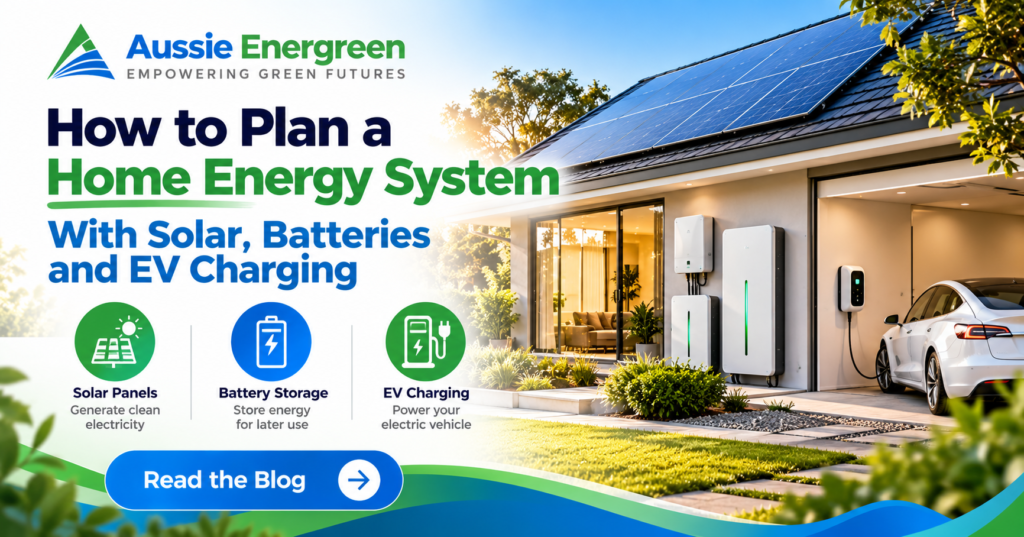
Australian households are finding new ways to generate, store and use electricity more efficiently. Rooftop solar panels, home battery storage and electric vehicle (EV) chargers are becoming important parts of modern home energy planning.
Rather than installing each technology separately, homeowners can benefit from considering how these systems will work together. A well-planned home energy system can help you make better use of solar electricity, manage your household’s energy consumption and prepare for future changes in the way you use power.
Whether you already have solar panels or are starting from scratch, understanding how solar generation, battery storage and EV charging work together can help you make more informed decisions.
In this guide, Aussie Energreen explains how to plan a home energy system that suits your current lifestyle and future energy requirements.
What Is a Home Energy System?
A home energy system combines the equipment and technology used to generate, store, distribute and consume electricity within a property.
Depending on your needs, it may include:
- Rooftop solar panels
- A solar inverter
- Home battery storage
- An EV charger
- Household electrical appliances
- Smart energy monitoring and management technology
These components can work together to help your household use electricity more strategically.
For example, solar panels may generate electricity during the day, power your home and provide surplus energy to charge a battery or an electric vehicle. Stored energy can then be used when solar generation falls.
The exact setup depends on your property’s electrical infrastructure, energy consumption, equipment compatibility and preferred operating settings.
Step 1: Assess Your Household’s Electricity Usage
Before investing in solar panels, a battery or an EV charger, start by understanding how your household uses electricity.
Review your electricity bills and, where available, your smart meter data to identify your typical consumption patterns.
Consider the following:
- Average daily electricity consumption
- Electricity use during peak periods
- Daytime and evening energy requirements
- Seasonal changes in consumption
- High-energy appliances
- Plans to purchase an electric vehicle
- Potential future upgrades, such as electric hot water or heating
Understanding these factors helps you choose equipment that is appropriately sized for your household.
For instance, if your home uses most of its electricity after sunset, battery storage may allow you to use more of the solar electricity generated during the day.
If you regularly charge an EV at home, that additional demand should also be included in your energy assessment.
Step 2: Choose Solar Panels That Suit Your Home
Solar panels are often the starting point for an integrated home energy system. They convert sunlight into electricity that can be used to operate household appliances and other compatible equipment.
When planning a rooftop solar installation, several factors should be considered.
Roof space and orientation
The available roof area, direction and pitch can influence how much electricity your panels generate. Shading from trees, neighbouring buildings or other structures can also affect performance.
Current electricity consumption
Your electricity usage helps determine the system capacity that may be appropriate for your household.
Future energy requirements
Think about whether you plan to add a battery, purchase an EV or replace gas appliances with electric alternatives. These changes may increase your future electricity consumption.
Inverter capacity and compatibility
The inverter converts the direct current (DC) electricity generated by solar panels into alternating current (AC) electricity used by most household appliances. Its specifications and compatibility with other equipment are important when planning future upgrades.
A system designed around both current and expected electricity needs can provide greater flexibility than one based solely on today’s consumption.
Step 3: Consider Adding Home Battery Storage
Solar panels generally generate the most electricity during daylight hours, while many households use more power in the evening.
A home battery can store some of the excess solar electricity generated during the day so it can be used later.
Explore solar battery storage solutions to understand which options may suit your household and existing solar setup.
How solar and battery storage work together
Morning: Solar panels begin generating electricity, helping power household appliances.
Midday: Solar production increases. After meeting household demand, surplus electricity may charge the battery.
Evening: Solar generation decreases, and stored battery electricity can help supply suitable household loads.
Overnight: The battery may continue supplying electricity until its available charge is reduced, with grid electricity covering any remaining demand.
The actual energy flow depends on your system configuration, battery capacity, energy management settings and electricity plan.
How do you choose the right battery size?
Battery capacity should reflect how much electricity your household needs to store and use later.
Consider:
- Evening and overnight electricity consumption
- The amount of surplus solar energy available
- Whether backup power is required
- Battery usable capacity and power output
- Your budget and expected financial return
- Compatibility with your inverter and other equipment
A larger battery is not automatically better. The aim is to choose a system that fits your energy requirements without paying for capacity you may rarely use.
Step 4: Include EV Charging in Your Energy Plan
If you already own an electric vehicle or expect to purchase one, home charging should be considered when designing your energy system.
Charging an EV can add significantly to your household’s electricity consumption, depending on how far you drive and how frequently you recharge.
Before selecting a charger, consider:
- Your typical weekly driving distance
- How often you need to recharge
- When your vehicle is usually parked at home
- Whether daytime charging is practical
- Your preferred charging speed
- The available electrical capacity at your property
These details help determine whether a standard charging arrangement or a dedicated home EV charger is more suitable.
Explore Aussie Energreen’s website to discuss your home energy upgrade options, including EV charging.
Step 5: Make Better Use of Solar Energy for EV Charging
One advantage of combining rooftop solar with EV charging is the opportunity to charge your vehicle using electricity generated at home.
When your vehicle is parked at home during daylight hours, surplus solar generation may be used for charging rather than exported to the electricity grid.
For example, your home’s energy system may operate in the following way:
- Solar panels generate electricity.
- Household appliances use the electricity required at that time.
- Available surplus electricity is directed towards EV charging, where the system supports it.
- Remaining surplus may be stored in a compatible battery or exported to the grid.
The best approach depends on your charging schedule, battery settings, electricity tariff and energy management equipment.
If your EV is usually away from home during the day, direct solar charging may be more difficult. In that situation, you may need to compare overnight charging rates, battery use and other available charging options.
Step 6: Integrate Solar Panels, Batteries and EV Charging
A combined solar, battery and EV charging setup can provide more flexibility than treating each component as an independent purchase.
A simplified system might look like this:
Solar panels → Inverter → Household electricity use
Surplus solar electricity can then be directed towards:
- Charging an EV
- Charging a home battery
- Exporting eligible excess electricity to the grid
When solar generation is low, the home may draw electricity from the battery or the grid, depending on the system’s settings and available stored energy.
The priority given to household appliances, EV charging and battery storage is not the same for every installation. It depends on the equipment, energy management configuration and the household’s preferences.
For example, a household that needs its EV ready for an early morning commute may prioritise vehicle charging. Another household may prefer to retain more battery energy for evening consumption.
A suitable energy management system can help coordinate these requirements where the selected equipment supports that functionality.
Step 7: Decide How to Prioritise Household Loads, Battery Storage and EV Charging
There is no single energy management strategy that suits every property. The right approach depends on your electricity plan, daily routine and energy priorities.
Electricity tariffs
If your electricity rates vary throughout the day, you may benefit from scheduling certain activities around lower-cost periods. Compare this with the potential value of storing solar electricity for later.
EV charging schedule
Households with vehicles parked at home during daylight hours may have more opportunities to use surplus solar generation directly.
Battery capacity
The available usable capacity influences how much electricity can be stored for later. Battery power output also affects how much load it can support at a particular time.
Household energy requirements
Your essential appliances, heating and cooling needs, and evening consumption should all be considered when choosing an operating strategy.
Energy management controls
Compatible smart controls may help coordinate battery charging, EV charging and household consumption. Confirm the available features before selecting equipment.
The aim is to balance convenience, energy use and costs rather than simply maximising the amount of electricity stored.
Step 8: Plan for Future Home Energy Upgrades
An effective home energy system should consider more than your immediate needs.
Your electricity consumption may increase if you:
- Purchase your first EV or add another vehicle
- Install a swimming pool
- Upgrade heating and cooling equipment
- Replace gas hot water with an electric heat pump
- Add new household appliances
- Increase the number of people living in your home
- Electrify additional household equipment
If you expect any of these changes, discuss them with your installer before finalising the system design.
Planning ahead may help you select suitable inverter capacity, compatible battery equipment and an electrical setup that can accommodate future upgrades.
Not every property needs every technology immediately. A staged installation may be appropriate, provided the initial system is designed with future compatibility in mind.
Step 9: Check Equipment Compatibility and Installation Requirements
Solar panels, batteries and EV chargers should be assessed as parts of the same broader system.
Before purchasing equipment, confirm the following:
Inverter and battery compatibility: Make sure the proposed battery works with the selected inverter and system configuration.
EV charger suitability: Check the charger’s power rating, vehicle compatibility and supported charging features.
Electrical capacity: A qualified installer should assess your property’s switchboard, supply and electrical requirements.
Backup power: If you want your home to operate during a blackout, confirm whether the proposed system supports backup operation and which circuits can be supplied.
Monitoring and control: Check whether the equipment allows you to monitor solar production, battery charge and EV charging.
Safety and compliance: Ensure the installation meets applicable Australian standards, regulations and network requirements.
Warranties and ongoing support: Review the equipment warranties, installation coverage and available service arrangements.
A professional assessment can help identify compatibility issues before installation and reduce the risk of unnecessary modifications later.
Key Benefits of an Integrated Home Energy System
When designed appropriately, a combined solar, battery and EV charging setup can provide several advantages.
1. Greater use of self-generated solar electricity
Surplus solar generation may be used to charge a battery or an EV instead of being exported to the grid.
2. Potentially lower electricity costs
Generating and storing electricity at home may reduce grid purchases, depending on your energy usage, tariffs and system performance. Savings are not guaranteed.
3. Convenient home EV charging
A dedicated home charger can make charging more convenient and reduce dependence on public charging locations.
4. More flexible energy management
Coordinating generation, storage and electricity consumption can give households more control over how and when energy is used.
5. Preparation for future electrification
Considering solar, battery storage and EV charging together can make future energy upgrades easier to plan.
Common Mistakes to Avoid When Planning Your System
Designing only for today’s electricity usage
If you intend to purchase an EV or electrify your hot water system, include the expected additional demand in your planning.
Choosing a battery based only on price
Compare usable capacity, power output, warranties, compatibility and installation costs instead of focusing solely on the advertised price.
Overlooking EV charging requirements
The right charger depends on your vehicle, driving routine, electrical supply and preferred charging speed.
Ignoring household energy patterns
A system’s value depends partly on when your household generates and consumes electricity. Review your usage before choosing system capacity.
Assuming all equipment works together
Solar inverters, batteries, chargers and energy management systems have different compatibility requirements. Confirm these before purchasing.
Expecting guaranteed savings
Results depend on electricity tariffs, energy consumption, installation costs, solar production, battery performance and other factors. Request a realistic assessment rather than relying on general savings claims.
How Aussie Energreen Can Help
Planning an integrated home energy system involves more than choosing individual products. The components need to suit your property, electricity consumption and future plans.
Aussie Energreen helps Australian households explore renewable energy and energy-efficiency solutions, including:
- Solar panel systems
- Home battery storage
- Solar and battery upgrades
- EV charging solutions
- Energy-efficient air conditioning
- Heat pump hot water systems
Whether you’re installing solar for the first time, adding a battery to an existing system or preparing your home for an electric vehicle, it is worth considering how your energy needs may change over time.
Our team can help you explore suitable options and understand the factors involved in planning your upgrade.
Contact Aussie Energreen
Website: https://aussieenergreen.com.au/
Phone: 1300 231 289
Email: info@aussieenergreen.com.au
Frequently Asked Questions
1. What is an integrated home energy system?
An integrated home energy system combines technologies such as solar panels, battery storage, EV charging and energy monitoring to help manage how electricity is generated, stored and used.
2. Do I need a battery if I already have solar panels?
Not necessarily. A battery may be useful if you regularly generate surplus solar electricity and want to use more of it later. Whether it offers good value depends on your usage patterns, electricity tariff, installation cost and other factors.
3. Can I charge my electric vehicle using solar panels?
Yes, if your EV charger and electrical system support the arrangement. Charging during periods of solar generation may allow you to use more of your own solar electricity.
4. Should I install solar panels before buying an EV?
You can plan for both at the same time, even if you install them in stages. Including your expected EV charging needs in the initial design may help you select suitable equipment and avoid unnecessary future changes.
5. Can a home battery power both my house and EV?
It depends on the battery’s usable capacity, power output, system configuration and the charging demand of the vehicle. EV charging can use substantial amounts of energy, so a battery may not be able to meet both demands fully.
6. Will solar and battery storage eliminate my electricity bills?
Not necessarily. Your home may still import electricity when solar production and stored energy are insufficient. The outcome depends on your usage, system size, tariffs and operating settings.
7. Can a solar battery provide power during a blackout?
Only if the system includes appropriate backup functionality and is installed accordingly. Confirm which household circuits can operate during an outage and how much power is available.
8. What is the best way to plan a solar, battery and EV charging system?
Start by reviewing your electricity consumption and future requirements. Then assess solar potential, battery needs, EV charging habits, equipment compatibility and installation costs with a qualified installer.
Final Thoughts
Planning a home energy system is about more than installing solar panels. It means considering how your home generates, stores and uses electricity today and how those requirements may change in the future.
By assessing your household consumption, choosing suitable solar equipment, evaluating battery storage and planning for EV charging, you can develop an energy system that better matches your lifestyle.
You do not have to install every component at once. The important step is to plan the system as a whole so that future upgrades can be considered from the beginning.
Ready to explore solar panels, battery storage and EV charging for your home? Contact Aussie Energreen to discuss your energy goals and available options.