
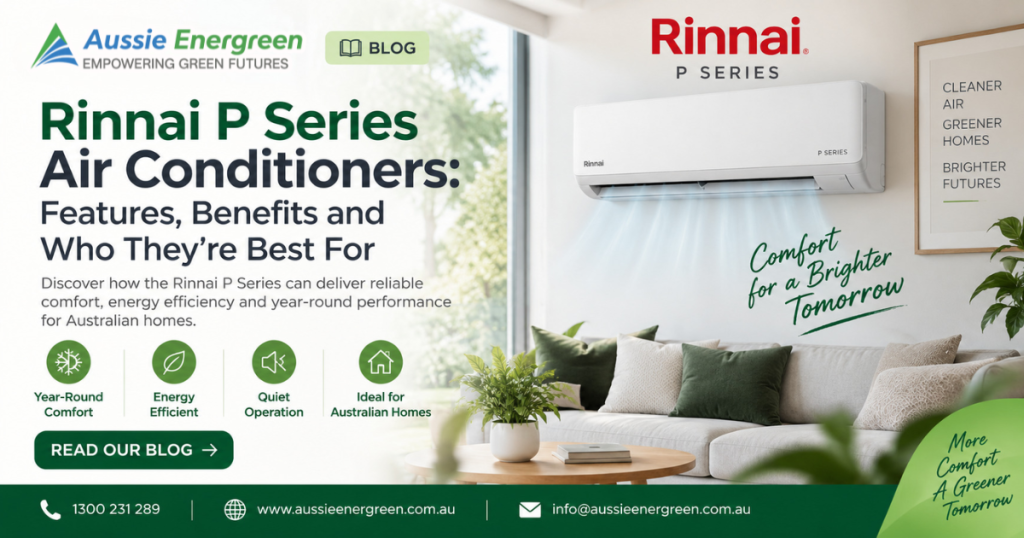
Choosing the right air conditioner is an important decision for Australian homeowners and small businesses. The ideal system should provide reliable heating and cooling, operate efficiently, suit the size of the space and remain practical to install and maintain.
The Rinnai P Series is a mainstream inverter split system range designed for everyday residential and light commercial applications. It offers a balance of performance, convenience and value without moving into the higher price range of premium air conditioning systems.
In this guide, Aussie Energreen explains what the Rinnai P Series is, how it works, its key features, available capacities and who may benefit from installing one.
What Is the Rinnai P Series?
The Rinnai P Series is a range of reverse-cycle inverter split system air conditioners. It is positioned as a versatile option for homeowners, builders and small business operators who need dependable heating and cooling without installing a ducted or multi-head system.
The range is suitable for applications such as:
- Bedrooms
- Living rooms
- Home offices
- Rumpus rooms
- Granny flats
- Retail stores
- Small offices
- Staff rooms
- Back-of-house areas
The P Series sits between Rinnai’s entry-level Q Series and its premium T Series. This makes it a practical middle-ground option for customers seeking useful features and reliable performance at a competitive price.
How Does a Split System Air Conditioner Work?
A split system air conditioner consists of two main units: an indoor unit and an outdoor unit. These units work together through a refrigerant circuit to transfer heat between the room and the outside environment.
Cooling Mode
During cooling operation:
- The indoor unit draws warm air from the room.
- The air passes over a cold evaporator coil.
- Heat from the room air is transferred into the refrigerant.
- The refrigerant carries the heat to the outdoor unit.
- The outdoor coil and fan release the heat into the outside air.
- The cooled air is circulated back into the room.
Heating Mode
In heating mode, the refrigerant cycle reverses. The outdoor unit extracts available heat from the outside air and transfers it indoors.
This allows the same system to provide both cooling in summer and heating during winter.
Main Components of the Rinnai P Series
A split system relies on several components working together correctly.
Indoor Unit
The indoor unit contains:
- Evaporator coil
- Indoor fan
- Air filters
- Temperature sensors
- Control electronics
- Airflow louvres
It is responsible for circulating conditioned air throughout the room.
Outdoor Unit
The outdoor unit houses:
- Compressor
- Condenser coil
- Outdoor fan
- Refrigerant components
- Electrical controls
The outdoor unit releases heat during cooling and absorbs heat from outside during heating.
Refrigerant Pair Coil
Insulated copper pipework connects the indoor and outdoor units. It carries refrigerant between the two units and must be installed correctly to ensure efficient operation.
Condensate Drain
During cooling, moisture is removed from the indoor air. The condensate drain carries this water away from the indoor unit to a suitable discharge point.
Every component must be correctly sized, connected and installed for the system to perform safely and efficiently.
Split System vs Window and Portable Air Conditioners
Compared with window and portable air conditioners, split systems offer several practical advantages.
Split System Benefits
- Quieter indoor operation because the compressor is outside
- Better efficiency for many room sizes
- Cleaner and more modern appearance
- More effective cooling and heating
- Greater control over temperature
- Suitable for long-term use
- Available in a wide range of capacities
Window air conditioners can be cheaper to install but may obstruct a window and create more indoor noise. Portable air conditioners are easier to move but generally rely on a duct hose and may lose efficiency through warm air entering the room.
For many Australian homes, a professionally installed split system is a more effective long-term solution.
Where the Rinnai P Series Fits in the Market
Rinnai is a recognised Japanese manufacturer with a long-standing presence in Australia across heating, hot water and home comfort products.
The company’s air conditioning range provides homeowners with another option from an established brand. Rinnai systems are distributed through Australian electrical and appliance supply networks and are supported by local warranty and service arrangements.
The P Series is designed to provide a balance between affordability and useful features. It is not positioned as the most basic air conditioner available, but it also avoids the higher price point associated with premium ranges.
What Makes the Rinnai P Series Different?
Depending on the model and production generation, the Rinnai P Series may include features such as:
- Inverter compressor technology
- Built-in Wi-Fi connectivity
- Gold Guard outdoor coil coating
- Reverse-cycle heating and cooling
- R32 refrigerant in newer models
- Multiple operating modes
- Sleep and quiet functions
- Adjustable airflow controls
The Gold Guard coating is designed to improve resistance against corrosion on the outdoor coil. This can be particularly useful in coastal environments where salt exposure may affect outdoor equipment.
Always confirm the specifications of the exact model before purchasing, as features and performance ratings can vary across the range.
Available Rinnai P Series Capacities
The Rinnai P Series covers a range of cooling capacities, generally spanning approximately 2.5kW to 8.0kW.
Common capacity options include:
- 2.5kW
- 3.5kW
- 5.0kW
- 6.0kW
- 7.1kW
- 8.0kW
Model codes may begin with HSNRP, followed by numbers representing the system capacity. For example, model codes such as HSNRP35B and HSNRP80B indicate different capacity options.
All systems in the range are reverse-cycle units, meaning they can provide both heating and cooling.
Which Rinnai P Series Size Is Right for Your Room?
The correct air conditioner size depends on more than floor area. Room orientation, insulation, windows, ceiling height and local climate can all affect the required capacity.
Small Rooms
For rooms up to approximately 20 square metres, smaller capacities such as 2.5kW or 3.5kW may be suitable.
These systems are commonly considered for:
- Standard bedrooms
- Small studies
- Home offices
- Guest rooms
- Smaller living spaces
Choosing a correctly sized unit helps avoid unnecessary energy use and excessive cycling.
Medium-Sized Living Areas
Capacities between 5.0kW and 6.0kW may suit rooms between approximately 25 and 45 square metres, depending on the property’s construction and climate.
These systems may be suitable for:
- Family living rooms
- Larger bedrooms
- Rumpus rooms
- Open living areas
- Home entertainment spaces
Larger Open-Plan Areas
The 7.1kW and 8.0kW models may be considered for larger open-plan spaces, including combined kitchen, dining and living areas.
For spaces larger than the practical capacity of a single split system, a multi-split or ducted system may provide better temperature distribution than relying on one oversized unit.
How to Correctly Size a Split System
A common starting point for cooling calculations is approximately 0.13kW to 0.15kW per square metre in an average insulated room. However, this should only be treated as a preliminary guide.
The required capacity may increase when the room has:
- Large west-facing windows
- Poor insulation
- High ceilings
- Significant afternoon sun
- Multiple occupants
- Heat-producing appliances
- An open connection to other rooms
- A hot or humid climate
A professional assessment is the best way to select the correct capacity. An undersized unit may run continuously without adequately cooling the room, while an oversized unit may reach the target temperature too quickly and fail to remove sufficient humidity.
Rinnai P Series Features and Technology
Inverter Compressor
The inverter compressor adjusts its operating speed according to the room’s heating or cooling demand.
Instead of repeatedly switching fully on and off, the compressor can slow down once the desired temperature is reached. This helps provide:
- More consistent indoor temperatures
- Smoother operation
- Reduced temperature fluctuations
- Lower energy use compared with older fixed-speed systems
- Improved comfort during extended operation
Wi-Fi Connectivity
Selected P Series models include built-in Wi-Fi connectivity, allowing users to control the system through a compatible app.
Depending on the model and app functionality, users may be able to:
- Turn the system on or off remotely
- Adjust the temperature
- Change operating modes
- Set schedules
- Prepare the room before arriving home
- Manage operation while away
Smart control can be especially useful for bedrooms, home offices and properties that are frequently unoccupied during the day.
Gold Guard Outdoor Coil Coating
The Gold Guard coating is designed to improve the outdoor coil’s resistance to corrosion.
This feature may be beneficial in areas exposed to:
- Coastal air
- Salt spray
- High humidity
- Moisture
- Harsh outdoor conditions
Although protective coatings can help, regular maintenance and correct outdoor unit placement remain important.
Multiple Operating Modes
The P Series may include several operating modes, such as:
- Cool
- Heat
- Dry
- Fan
- Auto
- Sleep
- Quiet
Each mode serves a different purpose. For example, Dry mode can help reduce humidity during muggy weather, while Sleep mode is designed for more comfortable overnight operation.
Airflow Control and Fan Settings
The Rinnai P Series provides different fan speed options and automatic fan control. In Auto mode, the system adjusts airflow based on the difference between the current room temperature and the selected temperature.
Adjustable louvres can help direct airflow around the room. Correct airflow positioning is important in bedrooms, offices and living areas where direct airflow may be uncomfortable.
For larger rooms, wide-angle airflow and swing functions can help distribute conditioned air more evenly.
Is the Rinnai P Series Quiet Enough for Bedrooms?
Smaller split system models are generally designed to operate quietly, particularly when used on lower fan settings.
The actual noise level depends on:
- Model size
- Fan speed
- Operating mode
- Indoor installation position
- Outdoor unit location
- Building construction
Larger units may produce more sound when operating at high capacity, but inverter technology can allow them to reduce speed once the room reaches the desired temperature.
During installation, the outdoor unit should be positioned carefully to reduce noise impact on bedrooms, neighbours and nearby windows.
Energy Efficiency and Running Costs
The Rinnai P Series models meet Australian energy performance requirements and carry energy rating information showing their heating and cooling efficiency.
When comparing systems, consider:
- Cooling star rating
- Heating star rating
- Annual energy consumption
- Rated capacity
- Maximum power input
- Expected operating hours
- Local electricity rates
A higher star rating can indicate better efficiency, but annual estimated energy use may provide a more useful comparison between models.
Example of Air Conditioner Running Costs
A 3.5kW split system operating for several hours each day during a Queensland summer may consume several hundred kilowatt-hours over a cooling season.
Actual running costs depend on:
- Outdoor temperature
- Indoor temperature setting
- Insulation
- Room size
- Operating hours
- Electricity tariff
- System efficiency
- Maintenance condition
For example, operating a system at 24°C generally uses less energy than setting it to 20°C or 21°C. Closing doors to unconditioned rooms and cleaning filters regularly can also help reduce energy consumption.
Reverse-Cycle Heating for Australian Winters
Reverse-cycle air conditioning is an efficient way to heat a home because it transfers heat rather than generating heat directly.
A reverse-cycle system may provide several kilowatts of heat for each kilowatt of electricity consumed, depending on outdoor conditions and operating efficiency. By comparison, a standard plug-in electric heater generally produces approximately one kilowatt of heat for each kilowatt of electricity used.
This makes reverse-cycle air conditioning a practical option for households that need both summer cooling and winter heating.
Rinnai P Series Compared with Other Brands
The Rinnai P Series competes with several established split system brands, including Daikin, Fujitsu, Mitsubishi Electric, Haier and other mid-range manufacturers.
When comparing systems, consider:
- Purchase price
- Energy ratings
- Wi-Fi availability
- Warranty terms
- Noise levels
- Capacity range
- Local servicing
- Installation requirements
- Long-term running costs
Premium brands may offer additional features, higher efficiency ratings or quieter operation on selected models. However, the Rinnai P Series can provide a strong balance of practical features and value for standard wall-mounted applications.
Rinnai P Series vs Premium Air Conditioners
A premium air conditioner may be worth considering when:
- Quiet operation is a top priority
- The system will run for long hours every day
- The highest energy rating is required
- Advanced filtration or control features are important
- Extended warranty support is a priority
- The property has demanding heating or cooling requirements
For many bedrooms, living rooms and home offices, however, a well-sized mid-range split system can provide reliable comfort without the higher upfront cost of a premium model.
Installation Requirements in Australia
Split system installation must be completed by appropriately licensed professionals.
Air conditioner installation involves:
- Electrical wiring
- Refrigerant handling
- Indoor unit mounting
- Outdoor unit mounting
- Copper pipe installation
- Condensate drainage
- System testing
- Commissioning
Electrical work must be completed by a licensed electrician, while refrigerant work must be performed by a suitably licensed refrigeration professional.
DIY installation is not legal in Australia and may compromise safety, system performance and warranty coverage.
Electrical and Circuit Requirements
Most residential split systems operate on a 240V single-phase electrical supply. Depending on the model and maximum current draw, the system may require a dedicated circuit.
The installer should assess:
- Switchboard capacity
- Available circuit space
- Cable length
- Circuit protection
- Outdoor isolator requirements
- Existing electrical infrastructure
Larger capacity systems may require additional electrical planning, particularly in older homes or properties with limited switchboard capacity.
Indoor and Outdoor Unit Placement
Correct placement helps improve performance and makes future servicing easier.
Indoor Unit Placement
The indoor unit should be installed where it has:
- Clear airflow
- Unobstructed return air
- Adequate wall strength
- Sufficient service access
- A suitable condensate drain route
Avoid positioning the indoor unit directly above a bed, desk or seating area where constant airflow may cause discomfort.
Outdoor Unit Placement
The outdoor unit requires:
- Adequate ventilation
- A level and stable mounting surface
- Sufficient clearance
- Protection from obstructions
- Accessible service space
- Minimal impact on neighbours
The pair coil route should be as short and direct as practical while still meeting installation requirements.
How Long Does Installation Take?
A standard back-to-back installation may take approximately three to six hours, depending on the property and installation conditions.
The process generally includes:
- Mounting the indoor unit
- Installing the outdoor unit
- Drilling and routing pipework
- Connecting refrigerant lines
- Installing the condensate drain
- Completing electrical connections
- Vacuum testing the system
- Checking for leaks
- Commissioning the unit
- Demonstrating the controls and Wi-Fi setup
More complex installations may take longer due to long pipe runs, multi-storey access, difficult mounting locations or electrical upgrades.
Maintenance and Long-Term Performance
Regular maintenance helps maintain airflow, efficiency and indoor air quality.
Clean the Filters
Indoor filters should generally be cleaned every four to six weeks during periods of heavy use. Dirty filters can restrict airflow and make the system work harder.
Keep the Outdoor Unit Clear
Remove leaves, grass, dust and other debris from around the outdoor unit. Blocked airflow can reduce performance and increase operating stress.
Schedule Professional Servicing
A professional service before the cooling season can include checks of:
- Refrigerant pressure
- Electrical connections
- Drain operation
- Indoor coil condition
- Outdoor coil condition
- Fan operation
- System performance
Some warranty conditions may require documented servicing, so homeowners should review the manufacturer’s warranty terms.
Common Rinnai P Series Problems
Reduced Cooling or Heating
Possible causes include:
- Dirty filters
- Blocked outdoor airflow
- Incorrect settings
- Low refrigerant
- Poor insulation
- Incorrect system sizing
Water Leaking Indoors
Water leaking from the indoor unit may indicate a blocked or incorrectly installed condensate drain.
Unusual Smells
Unpleasant smells may be caused by dust, mould or moisture build-up inside the indoor unit. Professional cleaning may be required.
Error Codes
Error codes displayed on the indoor unit can help technicians identify potential faults. Do not attempt electrical or refrigerant repairs yourself.
Contact a licensed technician if the system stops working, leaks water, produces unusual noises or displays an error code.
Who Is the Rinnai P Series Best For?
The Rinnai P Series may be a suitable choice for:
- Homeowners replacing older split systems
- Families needing reliable room-by-room comfort
- Builders installing air conditioning in new homes
- Owners of granny flats
- Home office users
- Small retail businesses
- Small offices
- Light commercial spaces
- Customers seeking built-in Wi-Fi
- Customers wanting a mid-range alternative to premium brands
The range is not intended for industrial cooling, large warehouses or specialist applications such as server room cooling. These environments require purpose-designed systems.
Why Choose Aussie Energreen?
At Aussie Energreen, we help homeowners and businesses select air conditioning systems that match their property, comfort needs and budget.
Our team can assist with:
- Air conditioner selection
- Capacity recommendations
- Site assessments
- Installation planning
- Electrical requirements
- Professional installation
- System commissioning
- Maintenance guidance
As a VEU Accredited Provider, Aussie Energreen can also help eligible Victorian customers understand available energy-efficiency upgrade opportunities and requirements.
Professional installation is essential to ensure your Rinnai P Series system operates safely, efficiently and reliably.
Final Thoughts
The Rinnai P Series is a practical inverter split system range designed for Australian homes and light commercial spaces. With reverse-cycle heating and cooling, multiple capacity options, smart control features and corrosion-resistant outdoor coil protection on selected models, it offers a useful balance between performance and value.
The most important step is selecting the correct capacity and ensuring the system is installed by qualified professionals. A properly sized and maintained air conditioner can provide dependable comfort while helping manage energy use over its operating life.
For expert advice and professional air conditioning installation, contact Aussie Energreen today.
Phone: 1300 231 289
Website: www.aussieenergreen.com.au
Email: info@aussieenergreen.com.au
Frequently Asked Questions
What is the Rinnai P Series?
The Rinnai P Series is a range of reverse-cycle inverter split system air conditioners designed for residential and light commercial applications.
What capacities are available in the Rinnai P Series?
The range generally includes capacities from approximately 2.5kW to 8.0kW, depending on model availability.
Does the Rinnai P Series provide heating and cooling?
Yes. The P Series is a reverse-cycle range, so it can provide cooling in summer and heating during winter.
Does the Rinnai P Series include Wi-Fi?
Selected P Series models include built-in Wi-Fi connectivity. Confirm the features of the exact model before purchasing.
Is the Rinnai P Series suitable for bedrooms?
Yes. Smaller models may be suitable for bedrooms when correctly sized. Quiet mode and low fan settings can improve overnight comfort.
Is the Rinnai P Series suitable for large open-plan areas?
Larger models may suit some open-plan spaces, but very large areas may require a multi-split or ducted system for better airflow distribution.
Can Aussie Energreen install Rinnai P Series air conditioners?
Yes. Aussie Energreen provides expert air conditioning advice and professional installation. Contact the team to discuss your property and system requirements