
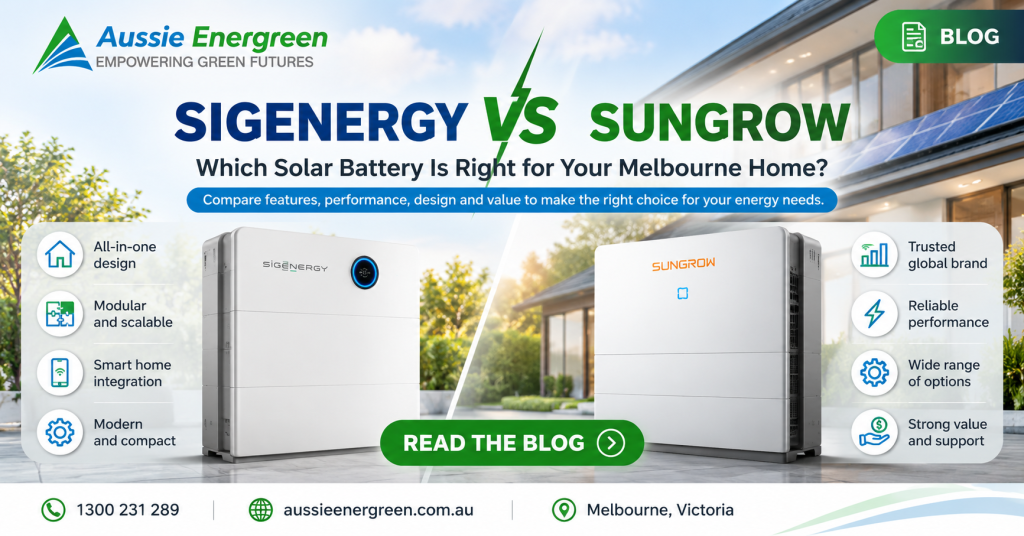
Choosing a home battery is an important decision for Melbourne households looking to make better use of their solar power. Two systems that are commonly considered are Sigenergy SigenStor and Sungrow’s residential battery solutions.
Both offer modular battery storage, solar integration and backup capabilities, but their system architecture and available features are different. The right option depends on your home’s electricity consumption, solar system, backup requirements, available space, EV plans and budget.
At Aussie Energreen, we help Melbourne homeowners compare solar and battery solutions based on how their property actually uses energy.
Sigenergy vs Sungrow: At a Glance
| Feature | Sigenergy SigenStor | Sungrow SBR + Hybrid Inverter |
|---|---|---|
| System design | Integrated 5-in-1 energy system | Battery + separate hybrid inverter |
| Battery chemistry | LiFePO₄ | LiFePO₄ |
| Modular battery | Yes | Yes |
| Battery capacity | Configurations up to 48.36 kWh per stack are documented for Australian three-phase systems | SBR range of 6.4–25.6 kWh per battery unit |
| Solar inverter | Integrated into Sigen Energy Controller | Separate Sungrow hybrid inverter |
| Energy management | Integrated EMS | iSolarCloud monitoring and management |
| EV integration | Optional 25 kW DC bidirectional charging module | Separate EV charging equipment |
| Backup | Backup capability integrated into the system architecture | Full-house backup available with compatible SH15/20/25T systems |
| Expansion | Modular and scalable | Modular and expandable |
| Best suited to | Homes wanting an integrated energy ecosystem | Homes wanting a modular Sungrow solar-storage system |
Specifications vary by model and installation configuration, so a site-specific assessment is important.
What Is Sigenergy SigenStor?
SigenStor is designed as an integrated energy storage platform rather than simply a battery connected to a separate inverter.
Sigenergy describes SigenStor as a 5-in-1 system, combining the solar inverter, battery PCS, battery pack, energy management system and EV DC charging capability within one integrated platform.
The system uses SigenStor BAT modules, including 5.0 and 8.0 kWh models. Australian documentation lists configurations reaching 48.36 kWh total capacity in certain three-phase configurations, with 46.8 kWh usable energy.
This modular approach can be useful for households that expect their electricity requirements to increase over time.
Key SigenStor features
- Integrated energy management
- Modular battery design
- LiFePO₄ battery chemistry
- Solar inverter integrated into the system
- Backup functionality
- App-based monitoring
- Optional DC EV charging
- V2X functionality designed for compatible EVs and future standards
- Capacity expansion through additional battery modules
Sigenergy also lists a 25 kW bidirectional DC EV charging module, although V2X functionality depends on compatible vehicles and applicable standards.
What Is Sungrow Solar Battery Storage?
Sungrow takes a somewhat different approach. Its Australian residential storage range includes the SBR high-voltage LFP battery, which is paired with compatible Sungrow hybrid inverters.
The current SBR range supports 6.4 to 25.6 kWh per battery unit, using 3.2 kWh modules. Sungrow states that the system can use two to eight modules per unit, depending on configuration.
Sungrow also offers compatible three-phase hybrid inverters, including the SH5/6/8/10/12T range and higher-capacity SH15/20/25T models.
Key Sungrow features
- High-voltage LiFePO₄ battery technology
- Modular battery architecture
- Expandable storage
- Up to 100% depth of discharge according to Sungrow’s current SBR product information
- Compatible three-phase hybrid inverters
- Smartphone monitoring through iSolarCloud
- Full backup options with compatible inverter configurations
1. System Design: Integrated vs Modular Components
One of the biggest differences is how the systems are designed.
Sigenergy
SigenStor combines multiple energy-management components into one integrated platform. This can reduce the number of separate major components required around the installation.
The system integrates:
Solar → Inverter → Battery → Energy Management → EV Charging
within its broader SigenStor ecosystem.
Sungrow
Sungrow generally uses a modular architecture where the battery and hybrid inverter are separate components.
For example, an SBR battery can be paired with compatible Sungrow hybrid inverters, including three-phase models.
For Melbourne homeowners, the physical layout, switchboard configuration and available installation space can therefore be important when comparing the two.
2. Battery Capacity and Scalability
Battery capacity should be based on how much electricity your home actually uses, rather than simply choosing the largest available battery.
Sigenergy
Australian SigenStor documentation shows configurations from smaller systems through to larger three-phase systems using multiple 8.0 kWh battery modules. Certain configurations reach 48.36 kWh total capacity.
This provides considerable flexibility for homes with higher energy consumption.
Sungrow
The current SBR battery range provides configurations from 6.4 kWh to 25.6 kWh per battery unit. The system uses modular 3.2 kWh battery units and can be expanded within the manufacturer’s supported configuration.
For a typical Melbourne home, the appropriate capacity depends on:
- Daily electricity consumption
- Existing solar capacity
- Evening electricity usage
- Air conditioning requirements
- Heat pump hot water usage
- EV charging
- Desired backup duration
- Available installation space
3. Solar Integration
Both systems can be integrated with solar PV to store excess daytime generation for later use.
A typical Melbourne household may generate significant solar power during the day when electricity consumption is relatively low.
Instead of exporting all surplus generation, a battery can store some of that energy for use later.
For example:
Solar generation → Home consumption → Battery charging → Grid export
Then during the evening:
Battery → Home appliances → Reduced grid consumption
The actual benefit depends on the home’s solar production, electricity consumption profile, electricity tariff and battery configuration.
4. Backup Power During Outages
Backup capability is another important consideration for Melbourne homeowners.
Sungrow’s SH15/20/25T three-phase hybrid inverter range includes a built-in 63A bypass for whole-home backup and a stated 10 ms seamless switching capability. Sungrow also specifies peak backup output of up to 36.5 kVA for the SH25T for 10 seconds.
Sigenergy’s Australian SigenStor documentation also specifies 0 ms disruption time for its backup switch in the documented configurations.
However, backup does not automatically mean every appliance can operate during an outage. The available backup power depends on the inverter, battery size, switchboard configuration and loads connected to the backup circuit.
A professional installer should determine which appliances need backup before designing the system.
5. EV Charging and Future Energy Needs
This is an area where Sigenergy has a particularly integrated product architecture.
SigenStor can incorporate the company’s Sigen EV DC Charging Module, with a maximum charging power of up to 25 kW. Sigenergy also markets bidirectional charging and V2X capabilities, subject to vehicle compatibility and applicable standards.
This could be relevant for Melbourne households planning to combine:
- Solar panels
- Home battery storage
- EV charging
- Future vehicle-to-home technology
Sungrow also offers EV charging products in Australia, including AC charging equipment, but its residential battery architecture separates the battery/inverter system from the EV charger.
6. Monitoring and Energy Management
Understanding where your electricity is going can help you make better use of your solar and battery system.
Sigenergy incorporates an energy management system into the SigenStor architecture and provides app-based energy monitoring.
Sungrow provides monitoring and management through its iSolarCloud platform. Sungrow states that users can monitor and manage their PV and energy-storage system through the platform.
For Melbourne households, monitoring can help identify:
- Solar generation
- Household consumption
- Battery charging
- Battery discharge
- Grid imports
- Solar exports
- Energy usage patterns
7. Battery Chemistry and Safety
Both systems use lithium iron phosphate (LiFePO₄/LFP) battery technology.
Sungrow’s SBR range uses LiFePO₄ battery cells and incorporates multiple protection features.
Sigenergy’s SigenStor BAT 5.0 and 8.0 batteries also use LiFePO₄ technology, with the company describing a five-layer battery safety protection system.
Battery safety also depends on correct system design, installation, electrical protection, ventilation/clearances where required, commissioning and ongoing maintenance.
8. Which Battery Size Is Suitable for a Melbourne Home?
There isn’t one battery size that suits every Melbourne property.
A household using relatively little electricity may not need a large battery.
On the other hand, a home with:
- Ducted air conditioning
- Heat pump hot water
- Pool equipment
- Multiple refrigerators
- An EV
- High evening electricity consumption
may require considerably more storage.
A simple example
Suppose a household:
- Generates substantial solar energy during the day
- Uses most electricity in the evening
- Has an EV
- Wants some backup capacity
A larger modular battery system may be considered.
But if the same household has low electricity consumption, installing significantly more storage than it can regularly use may not make financial sense.
The correct approach is to analyse solar generation + electricity consumption + tariff + battery capacity + backup requirements together.
Sigenergy vs Sungrow: What Should Melbourne Homeowners Consider?
Rather than choosing a battery based only on the brand, consider the complete system.
Consider Sigenergy if you are interested in:
- An integrated energy-storage ecosystem
- Modular battery expansion
- Integrated energy management
- Future EV integration
- Bidirectional EV charging capabilities
- A compact integrated system architecture
- Larger scalable configurations
Consider Sungrow if you are looking for:
- A modular LFP battery system
- Separate battery and inverter architecture
- A broad range of compatible hybrid inverters
- Three-phase options
- Full-house backup with compatible configurations
- Established energy monitoring through iSolarCloud
- Expandable battery capacity
These are feature differences rather than a universal ranking. The suitability of either system depends on the property and the system design.
Installation Considerations in Melbourne
Melbourne homes can have very different electrical configurations.
Before selecting a battery, an installer should assess:
Solar system
How much solar generation does the existing or proposed PV system provide?
Electricity consumption
How much electricity is used during the day and evening?
Switchboard
Is the existing switchboard suitable for the proposed system?
Phase configuration
Is the home single-phase or three-phase?
Backup requirements
Which appliances need to operate during a power outage?
Battery location
Is there a suitable location that meets installation and safety requirements?
Future upgrades
Are you planning to install:
- An EV charger?
- A heat pump hot water system?
- Additional solar panels?
- More air conditioning?
- An induction cooktop?
Planning these requirements early can help avoid unnecessary system changes later.
Why Choose Aussie Energreen?
At Aussie Energreen, we help Melbourne homeowners explore solar and battery solutions based on their individual energy requirements.
Our energy solutions include:
- Solar panel systems
- Solar battery storage
- Hybrid solar systems
- Home energy solutions
- Heat pump hot water systems
- Air conditioning
- EV charging solutions
- Commercial energy solutions
Our team can assess your current electricity usage and discuss suitable battery configurations for your property.
Summary Sigenergy vs Sungrow Solar Battery Melbourne
Sigenergy vs Sungrow Solar Battery Melbourne offer different approaches to home energy storage.
Sigenergy focuses on an integrated ecosystem that combines solar conversion, battery storage, energy management and optional EV charging technologies. Its Australian documentation also shows highly scalable configurations.
Sungrow offers a modular battery-and-inverter approach, with its SBR battery range currently covering 6.4–25.6 kWh per unit, alongside compatible hybrid inverters ranging from smaller residential systems to higher-power three-phase models.
For a Melbourne home, the important question is not simply “Which brand is better?” It is which system configuration matches your electricity usage, solar generation, backup requirements, property and future energy plans.
A professional assessment can help determine the appropriate battery capacity, inverter configuration and installation requirements.
Frequently Asked Questions Sigenergy vs Sungrow Solar Battery Melbourne
1. Is Sigenergy available in Melbourne?
Sigenergy provides Australian-market SigenStor products, including SigenStor energy controllers and battery modules. Availability, installation and final system configuration should be confirmed with an authorised installer.
2. How much battery storage do I need for my Melbourne home?
It depends on your electricity consumption, solar generation, evening usage, EV charging and backup requirements. A household energy assessment is recommended before selecting a battery size.
3. Can Sigenergy charge an EV?
Yes. Sigenergy offers a Sigen EV DC Charging Module with charging power up to 25 kW. Bidirectional/V2X functions depend on compatible vehicles and applicable standards.
4. Can Sungrow provide whole-home backup?
Compatible Sungrow configurations can provide whole-home backup. The SH15/20/25T range, for example, includes a built-in 63A bypass and 10 ms seamless switching specification. Actual backup capability depends on the installed system and electrical configuration.
5. Are both Sigenergy and Sungrow batteries lithium iron phosphate?
Yes. The referenced SigenStor and Sungrow SBR battery products use LiFePO₄ battery chemistry.
6. Can I add more battery capacity later?
Both platforms use modular designs, but expansion limits depend on the specific model and installation configuration. The system should be designed with future expansion in mind from the beginning.
7. Can I install a battery without solar panels?
Battery systems can be configured in different ways, but whether a particular battery can be installed without an existing or new solar system depends on the product configuration, inverter and electrical design. A professional assessment is recommended.
8. Which battery is suitable for a three-phase Melbourne home?
Both brands offer three-phase solutions. Sigenergy’s Australian SigenStor range includes three-phase energy controllers, while Sungrow offers three-phase hybrid inverters including the SH15/20/25T.
Get a Solar & Battery Assessment in Melbourne Sigenergy vs Sungrow Solar Battery Melbourne
Thinking about adding a solar battery to your Melbourne home?
Aussie Energreen can help you understand your solar and battery options and design a system around your home’s energy requirements.
📞 1300 231 289
📧 info@aussieenergreen.com.au
🌐 www.aussieenergreen.com.au