
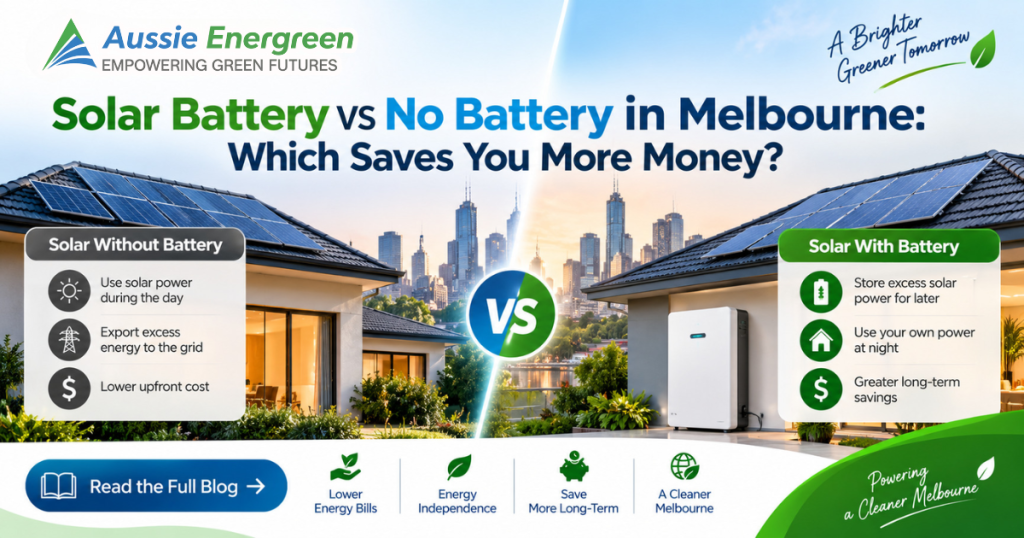
For Melbourne homeowners, installing solar panels can be an effective way to reduce reliance on grid electricity. But once you have solar, an important question remains: should you add a solar battery, or is solar without a battery the better financial choice?
Solar panels generate the most electricity during daylight hours, while many households use a significant amount of electricity in the evening. A solar battery can store some of the excess electricity generated during the day and make it available later.
However, a battery also adds to the upfront cost of a solar system. Whether it saves you more money depends on your electricity usage, solar generation, energy prices, battery cost and how much of your solar power you can use directly.
This guide looks at solar with a battery versus solar without a battery and the factors Melbourne homeowners should consider before making a decision.
How Solar Panels Work Without a Battery
A standard solar PV system generates electricity whenever sunlight is available.
During the day, your home can use the solar electricity as it is generated. If your solar system produces more electricity than your home needs at that moment, the excess can generally be exported to the electricity grid, subject to your retailer and connection arrangements.
For example:
Solar panels → Home electricity use → Excess electricity → Grid
This setup can be relatively straightforward and has a lower upfront cost than adding battery storage.
However, one of the challenges is that solar generation and household electricity consumption don’t always occur at the same time.
How Solar Batteries Change the Equation
A solar battery provides a way to store some excess solar electricity for later use.
Instead of exporting all unused solar generation, a battery can store available energy and make it available when solar production falls.
A simplified setup looks like:
Solar panels → Home → Battery → Home at a later time
For example, excess electricity generated during the afternoon could be stored and later used in the evening when household electricity demand increases.
This can increase the amount of your solar generation that you use within your home rather than exporting it.
Solar Without a Battery: Key Advantages
Choosing solar without battery storage can make sense for some households.
Lower Upfront Investment
The most obvious advantage is that you don’t have to purchase a battery at the same time as your solar system.
This can make the initial solar installation more affordable.
For homeowners primarily looking to reduce their daytime electricity purchases, solar panels alone may provide a suitable starting point.
Simpler System
A solar PV system without battery storage has fewer components than a solar-plus-battery setup.
There is no battery to install, monitor or eventually replace, although solar systems still require appropriate installation and ongoing maintenance.
Make Use of Daytime Solar
Homes with high daytime electricity consumption may already use a significant portion of their solar generation directly.
For example, households that regularly operate:
- Air conditioning
- Pool pumps
- Hot water systems
- Washing machines
- Dishwashers
- Home office equipment
during daylight hours may be able to consume more solar electricity directly.
Solar With a Battery: Key Advantages
Adding battery storage changes how your solar electricity can be used.
Store Excess Solar Energy
Instead of immediately exporting excess solar generation, a battery can store some of that electricity for later use.
This can be useful when your household produces more solar electricity during the day than it consumes.
Use Stored Solar at Night
Solar panels don’t generate electricity after sunset.
A battery can provide stored electricity during the evening, depending on its available capacity and state of charge.
This can help reduce the amount of electricity you need to purchase from the grid during those periods.
Increase Solar Self-Consumption
One of the main reasons homeowners consider batteries is to increase the proportion of their solar generation that is used within the household.
Without a battery:
Daytime solar → Home + grid export
With a battery:
Daytime solar → Home + battery → Evening home use
The potential value depends on how much excess solar electricity is available and how much energy the household uses after solar production declines.
Solar Battery vs No Battery: Quick Comparison
| Feature | Solar Without Battery | Solar With Battery |
|---|---|---|
| Upfront cost | Lower | Higher |
| Daytime solar use | Yes | Yes |
| Store excess solar | No | Yes |
| Evening solar use | Limited to grid supply | Stored energy can be used |
| Grid reliance | Reduced | Can be reduced further |
| Energy independence | Moderate | Greater potential |
| System complexity | Lower | Higher |
| Battery maintenance/replacement | Not applicable | Battery has a finite service life |
Which Option Saves More Money?
There isn’t a universal answer.
A battery may provide greater long-term value for some households, while solar without a battery may deliver a better financial return for others.
The key question is:
How much value can you get from the electricity stored in the battery compared with the battery’s purchase and installation cost?
Several factors influence the answer.
1. Your Household Electricity Usage
Your energy consumption pattern is one of the most important considerations.
If most of your electricity is used during daylight hours, solar panels may already cover a large portion of your consumption.
If your household uses significant electricity in the evening, battery storage may have greater potential value.
2. How Much Solar Electricity You Export
A household that regularly exports a large amount of excess solar electricity may have more opportunity to benefit from battery storage.
However, exporting electricity also provides financial value through your applicable feed-in arrangement.
Therefore, the comparison shouldn’t simply be “battery versus free electricity”. You need to compare the value of storing and later using the electricity against the value you would otherwise receive from exporting it.
3. Your Electricity Tariff
Electricity pricing can influence the potential benefit of battery storage.
The financial outcome depends on factors including:
- Electricity usage rates
- Feed-in arrangements
- Time-of-use pricing
- Daily household consumption
- Retailer plan
- Battery operating strategy
These factors can change over time, so calculations should use current pricing rather than assumptions.
4. Battery Cost
Solar batteries represent a significant additional investment.
The financial benefit needs to be considered against:
- Purchase price
- Installation costs
- Available incentives or rebates
- Expected usable capacity
- Warranty
- System efficiency
- Expected operating life
A battery that is expensive relative to the energy savings it delivers may take longer to recover its cost.
What Size Solar Battery Do You Need?
Bigger isn’t always better when it comes to battery storage.
The ideal battery capacity depends on how much excess solar electricity your household produces and how much electricity you use after sunset.
For example, a household with relatively low evening electricity consumption may not benefit financially from installing a very large battery.
On the other hand, a household with high evening consumption and substantial excess solar generation may have a greater need for storage capacity.
Battery sizing should therefore be based on actual household energy data, rather than simply choosing the largest available battery.
Can a Solar Battery Help During a Power Outage?
Some battery systems can provide backup power during a grid outage, but not every solar battery installation automatically provides backup.
Backup capability depends on the battery, inverter, system configuration and installation.
If backup power is important to you, discuss this requirement before selecting your system.
Solar Battery and Air Conditioning
Air conditioning can significantly influence how a Melbourne household uses electricity.
Solar panels can help supply electricity to air conditioning during the day. A battery may then provide stored energy for some household loads after solar generation declines.
However, air conditioning can be a relatively high electricity load, so battery sizing should take your actual consumption into account.
If your household regularly operates heating or cooling in the evening, this should be included when assessing whether battery storage is worthwhile.
Solar Battery and Hot Water
Hot water is another important energy load to consider.
A household may be able to use excess solar electricity to operate an electric hot water or heat pump hot water system during periods of solar generation.
This can reduce the amount of excess solar electricity that needs to be exported and may reduce the need to store as much energy in a battery.
For this reason, a home’s overall energy management strategy can be just as important as the battery itself.
Is Solar Without a Battery Still Worth It?
Absolutely.
A solar system doesn’t need a battery to provide value.
Solar panels can reduce the amount of electricity a household purchases from the grid by generating electricity on-site.
Solar without a battery may be particularly attractive if:
- Your budget is limited
- You use significant electricity during the day
- Your solar system is well matched to your consumption
- You want a simpler installation
- You are not ready to invest in battery storage
You can also consider adding a battery later, provided the existing system is compatible with the proposed upgrade.
When Might a Solar Battery Make Sense?
Battery storage may be worth considering if:
- Your household uses substantial electricity after sunset
- You regularly export excess solar electricity
- You want greater energy independence
- You want to increase solar self-consumption
- You have suitable solar generation
- You are interested in battery backup capability
- Your energy usage pattern supports battery charging and discharging
The financial case should be calculated using your actual electricity consumption and current energy pricing.
How to Compare the Payback
A simple battery payback calculation compares the additional cost of the battery with the estimated annual value it provides.
The value can come from several sources, including:
Reduced grid electricity purchases + applicable energy benefits − lost export value
The calculation should also account for battery efficiency, usable capacity, degradation, installation costs and expected service life.
Because electricity prices, feed-in arrangements and battery costs vary, a personalised assessment is generally more useful than relying on a generic payback figure.
Should You Install Solar and a Battery Together?
For some homeowners, installing solar and battery storage together can make sense.
For others, installing solar first and evaluating their electricity usage before adding a battery may be the better approach.
If you’re considering both, look at:
- Your annual electricity consumption
- Your daytime electricity usage
- Your evening electricity usage
- Your current solar generation
- Your excess solar exports
- Your electricity tariff
- Battery cost and warranty
- Your future energy requirements
This information can provide a much clearer picture of whether battery storage is financially worthwhile.
Why Professional System Design Matters
Solar and battery systems should be designed around the property rather than using a one-size-fits-all approach.
At Aussie Energreen, system planning can take into account your home’s energy consumption, solar generation, available roof space and future energy requirements.
Whether you are considering solar panels alone or a solar-and-battery system, the goal is to select equipment and capacity that align with how your household actually uses electricity.
Solar Battery vs No Battery: What’s Best for Your Melbourne Home?
The right choice depends on your household.
Solar without a battery may suit you if:
- You want a lower upfront investment
- You use plenty of electricity during daylight hours
- You want a simpler system
- You are comfortable exporting excess solar electricity
Solar with a battery may suit you if:
- You have significant evening electricity consumption
- You regularly generate excess solar electricity
- You want to use more of your own solar energy
- Greater energy independence is important to you
- You want to explore battery backup options
There is no single solution that will provide the best financial outcome for every Melbourne household.
Choose the Right Solar Solution With Aussie Energreen
At Aussie Energreen, we help Melbourne homeowners understand their solar and battery options based on their individual energy requirements.
Whether you’re considering a new solar system, adding battery storage or upgrading an existing installation, professional system design can help you make a more informed decision.
📞 1300 231 289
📧 info@aussieenergreen.com.au
🌐 aussieenergreen.com.au
Aussie Energreen – Empowering Green Futures.
Final Thoughts
So, does a solar battery save more money than solar without a battery?
It depends.
Solar panels can reduce grid electricity purchases by generating power during the day. A battery can go a step further by storing some excess solar energy for later use.
For households with significant evening energy consumption, a battery may provide additional value. For homes that use most of their electricity during the day, solar without a battery may offer a simpler and more cost-effective solution.
The best decision comes from looking at your actual electricity usage, solar generation, export patterns, energy prices and battery costs.
Rather than choosing based on the idea that every home needs a battery, compare both options based on your household’s individual energy profile.
Frequently Asked Questions
Is solar with a battery cheaper than solar without a battery?
Not necessarily. A battery increases the upfront investment, so its financial benefit depends on how much stored energy you can use and the value of that energy.
Does a solar battery eliminate electricity bills?
No. A solar battery can reduce grid electricity consumption, but it does not necessarily eliminate electricity bills. Results depend on system size, household consumption, energy prices and other charges.
Is a battery worth it in Melbourne?
It can be worthwhile for some Melbourne households, particularly those with substantial evening electricity consumption and excess solar generation. A personalised calculation is recommended.
Can I add a battery to my existing solar system?
In many cases, yes, although compatibility depends on your existing solar inverter, system design and the battery technology selected.
Should I get a bigger solar battery?
Not necessarily. Battery capacity should be matched to your household’s energy consumption and available solar generation. An oversized battery can add unnecessary cost.
Can a solar battery work during a blackout?
Some systems can provide backup power, but backup functionality depends on the battery, inverter and installation configuration.
Is solar without a battery still a good investment?
It can be. Solar panels can reduce grid electricity purchases without the additional cost of battery storage. The best option depends on your energy usage and financial goals.