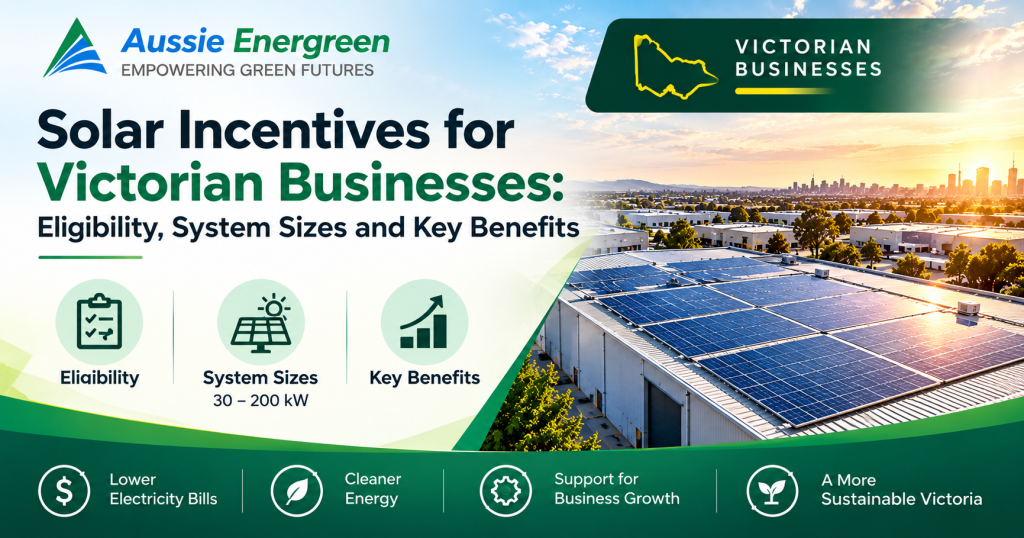
Businesses across Victoria are increasingly looking at rooftop solar as a way to manage electricity costs, increase onsite renewable energy generation and support long-term energy planning. With the Victorian Energy Upgrades (VEU) program now providing upfront discounts for eligible commercial and industrial solar PV systems between 30kW and 200kW, businesses have another incentive to explore solar upgrades.
For businesses considering a new solar installation, understanding the eligibility requirements, system sizes and available incentives is an important first step. Solar Incentives for Victorian Businesses
What Is the Victorian Commercial and Industrial Solar Incentive?
The Victorian Energy Upgrades program provides discounts for eligible commercial and industrial solar PV installations.
The current VEU Commercial and Industrial Solar activity covers solar systems from 30kW to 200kW installed at eligible non-residential premises. Systems must meet the program’s technical, connection and product requirements.
The program is designed to provide an upfront incentive, helping reduce the initial cost barrier for businesses considering commercial solar.
Eligible businesses may also be able to access other incentives, depending on the size and characteristics of their solar installation.
Who Can Be Eligible?
The VEU commercial and industrial solar activity is available to Victorian businesses and other eligible non-residential sites.
Examples include:
- Factories
- Warehouses
- Retail businesses
- Offices
- Schools
- Hospitals
- Community buildings
- Agricultural and farming sites with eligible non-residential loads
- Other eligible commercial premises
The program also allows eligible businesses that rent their premises to participate, provided they have an agreement with the property owner or landlord.
Residential homes and residential apartment premises are not eligible under this particular commercial and industrial solar activity.
Some large energy-consuming facilities may have specific participation restrictions unless they opt into the VEU program, so individual eligibility should be confirmed before proceeding.
What Solar System Sizes Are Covered?
The commercial and industrial solar activity covers systems between:
30kW – 200kW
The appropriate size depends on factors such as electricity consumption, available roof space, daytime energy demand and future plans for electrification.
Solar Victoria provides the following examples of typical applications:
| Solar System Size | Example Applications |
|---|---|
| 30–50kW | Small to medium offices, retail sites, aged care facilities |
| 50–100kW | Warehouses, schools, hospitals, aquatic centres |
| 100–200kW | Larger warehouses and factory rooftops |
These are general examples rather than fixed rules. A site’s electricity consumption and physical characteristics should determine the appropriate system size.
What Are the Solar Incentive Amounts?
The value of the VEU discount varies according to system size and certificate value.
Solar Victoria’s current indicative figures include:
| Solar PV System | Indicative VEU Discount* |
|---|---|
| 50kW | $4,550 |
| 75kW | $6,860 |
| 100kW | $9,100 |
| 150kW | $25,760 |
| 200kW | $34,300 |
*These figures are indicative and based on a VEEC price of $70. Actual discounts can vary. The final installed cost can also be influenced by system size, equipment selection, certificate values, location, installation costs and provider charges.
Businesses may also be eligible for other renewable energy certificates depending on system size. Systems between 30kW and 100kW may be eligible for Small-scale Technology Certificates (STCs), while systems above 100kW and up to 200kW may be eligible for Large-scale Generation Certificates (LGCs), subject to the applicable requirements.
What Are the Main Eligibility Requirements?
For a commercial or industrial solar PV system to qualify under the VEU activity, the system must meet specific requirements.
These include:
- Installation at a non-residential premises
- System size between 30kW and 200kW
- Minimum inverter capacity of 30kVA
- Connection to the relevant electricity distribution network
- Compliance with the applicable DNSP negotiated connection contract
- Only one solar PV system per National Meter Identifier (NMI) under the activity
- An end-user-accessible monitoring portal
- Approved solar panels and inverters meeting the program’s product requirements
Solar panels and inverters must meet the relevant approved-product requirements, and warranty requirements also apply.
How Much Roof Space Is Needed?
Available roof area is another important factor when planning a commercial solar system.
As a general guide, Solar Victoria states that a 100kW system typically requires approximately 450m² to 600m² of clear roof area.
However, the exact space required can vary depending on:
- Panel wattage
- Panel dimensions
- Roof orientation
- Roof layout
- Shading
- Maintenance access
- Fire and safety requirements
- Structural considerations
A professional site assessment can determine whether the available roof is suitable for the proposed system.
How Can Solar Help Victorian Businesses?
Installing commercial solar can provide several potential benefits beyond the available incentive.
Lower Grid Electricity Consumption
Solar panels generate electricity onsite, which can reduce the amount of electricity a business needs to purchase from the grid when the system is producing power.
Greater Use of Renewable Energy
Businesses can generate electricity from a renewable source directly at their premises.
Daytime Energy Generation
Commercial properties often have significant daytime electricity demand. This can make rooftop solar particularly relevant for businesses operating during daylight hours.
Support for Electrification
Businesses planning to introduce technologies such as EV chargers, heat pumps or other electrical equipment may consider future electricity demand when sizing a solar system. Solar Victoria specifically recommends considering future load growth and electrification when planning system size.
Potential Long-Term Energy Planning
A properly designed solar system can become part of a broader business energy strategy, particularly when combined with energy efficiency measures and battery storage where appropriate.
What About Solar Systems Larger Than 200kW?
Businesses requiring a solar system larger than 200kW are not necessarily excluded from VEU support altogether.
Solar systems above 200kW may be considered under project-based Measurement and Verification (M&V) activities, subject to the applicable VEU requirements.
The M&V approach is different from the upfront deemed commercial and industrial solar activity and generally involves measuring the energy or emissions savings associated with the project.
Businesses considering larger systems should obtain advice on the appropriate VEU pathway before installation.
Can a Business Combine Solar With Battery Storage?
Solar PV and battery storage can be considered together as part of a broader energy strategy.
Solar panels generate electricity when sunlight is available, while a battery can store some generated electricity for later use.
This can potentially help businesses use more of their own generated energy outside solar production periods.
Current government battery programs have their own eligibility criteria, so businesses should check the latest requirements before assuming a battery incentive applies to their project.
What Should Businesses Consider Before Installing Solar?
Choosing a commercial solar system involves more than selecting a panel capacity.
Businesses should consider:
1. Electricity Consumption
Review electricity bills and identify when the business uses the most energy.
2. Daytime Load
Understand how much electricity is being consumed while the solar system is generating power.
3. Roof Area
Check the available roof space, shading and structural suitability.
4. Future Energy Requirements
Consider potential additions such as EV chargers, heat pumps, refrigeration equipment or other electrical loads.
5. Grid Connection
The proposed system needs to comply with the relevant distribution network requirements and connection arrangements.
6. Equipment
Solar panels and inverters must meet the applicable program requirements and approved-product standards.
7. Incentive Eligibility
Eligibility should be confirmed before work begins, as program requirements and certificate values can change.
Why Professional Solar Design Matters
Commercial solar installations are significantly more complex than many residential systems.
A proper design should consider:
- Historical electricity consumption
- Roof orientation
- Shading
- Panel layout
- Inverter capacity
- Electrical infrastructure
- Grid connection requirements
- Future electricity demand
- Monitoring
- Maintenance access
- Applicable incentives
The VEU program requires eligible installations to be completed through appropriately accredited providers, and the solar system must meet the relevant program requirements.
Frequently Asked Questions Solar Incentives for Victorian Businesses
What is the minimum solar system size for the Victorian C&I solar incentive?
The current VEU Commercial and Industrial Solar activity covers systems from 30kW to 200kW.
Can warehouses and factories qualify?
Eligible warehouses and factories can qualify because the program applies to eligible non-residential premises, subject to all technical and program requirements.
Can a business that rents its building apply?
Yes, eligible business renters can participate if they have reached an agreement with the property owner or landlord.
Can schools receive the commercial solar incentive?
Yes. Both primary and secondary schools are identified as eligible non-residential sites under the C&I solar activity, subject to the program requirements.
Can a 200kW solar system receive other incentives as well?
Depending on the system and applicable requirements, businesses may be eligible for other renewable energy certificates in addition to the VEU discount.
Can businesses install more than 200kW of solar?
Yes, larger systems can be considered under other VEU pathways, including project-based Measurement and Verification activities, subject to eligibility requirements.
Does the incentive cover the entire cost of a solar installation?
No. The VEU program provides a discount based on the eligible activity and certificate value. The actual project cost depends on the system, equipment, installation requirements and other factors.
Final Thoughts Solar Incentives for Victorian Businesses
The Victorian commercial and industrial solar incentive provides an opportunity for eligible businesses to reduce the upfront cost of installing qualifying solar PV systems between 30kW and 200kW.
For businesses considering solar, the first step is to understand electricity consumption, available roof space and future energy requirements. From there, the appropriate system size and potential incentives can be assessed.
Because eligibility, certificate values and program requirements can change, businesses should confirm the latest rules before committing to an installation.
Explore Solar Incentives for Victorian Businesses With Aussie Energreen
Aussie Energreen helps Victorian businesses explore solar and energy solutions designed around their property and energy requirements.
📞 1300 231 289
📧 info@aussieenergreen.com.au
🌐 www.aussieenergreen.com.au
📍 Melbourne, Victoria
Aussie Energreen – Empowering Green Futures
Check the current Victorian commercial and industrial solar requirements