Commercial solar is becoming an increasingly important investment for Australian businesses looking to reduce electricity costs, improve energy independence and support long-term sustainability.
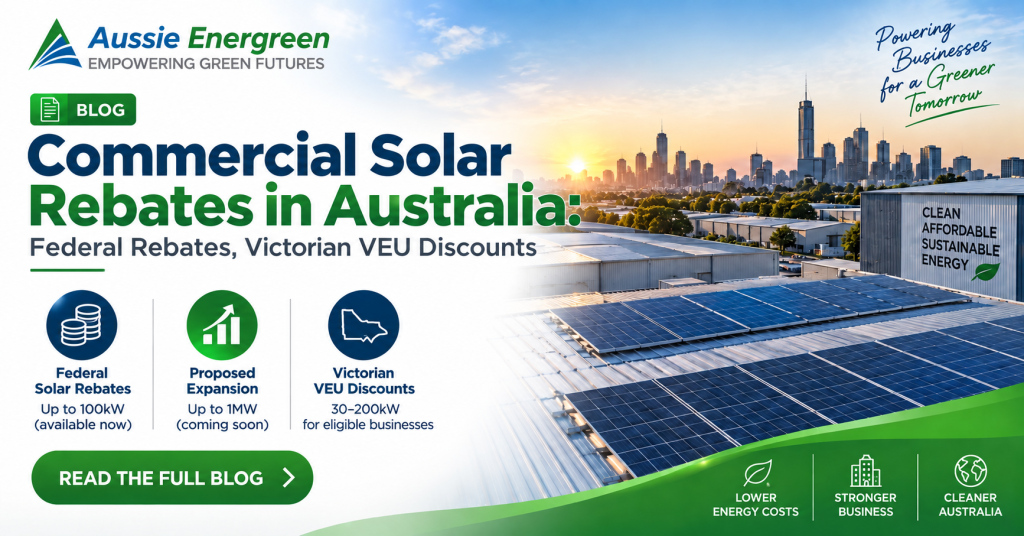
Recent changes announced by the Australian Government could make larger commercial solar installations more accessible. The proposed expansion of the Small-scale Renewable Energy Scheme (SRES) would extend eligibility from systems up to 100kW to solar installations between 100kW and 1MW, subject to the required regulations being introduced.
For businesses operating warehouses, factories, offices, retail sites and agricultural facilities, this could create new opportunities to reduce the upfront cost of solar installation.
What Are Commercial Solar Rebates?
Commercial solar rebates are financial incentives that help reduce the cost of installing eligible solar photovoltaic systems.
In Australia, commercial solar projects may be supported through different schemes depending on:
- System size
- Installation location
- Installation date
- System design
- Approved products
- Connection arrangements
- Applicable government requirements
The main incentives relevant to commercial solar include:
- Federal Small-scale Technology Certificates (STCs)
- Large-scale Generation Certificates (LGCs)
- Victorian Energy Upgrades (VEU) discounts
- Other state or project-based incentives
The incentive available to a business depends on the size and eligibility of the proposed system.
Federal Commercial Solar Rebates Through STCs
Under the current Small-scale Renewable Energy Scheme, eligible solar PV systems with a capacity of no more than 100kW may qualify for Small-scale Technology Certificates.
STCs are based on the amount of renewable electricity a system is expected to generate over its applicable deeming period. The certificates can generally be assigned to a registered agent in exchange for an upfront discount on the solar installation price.
The value of the discount depends on factors such as:
- System capacity
- Location
- Installation date
- Certificate market value
- Applicable deeming period
- System eligibility
The Clean Energy Regulator confirms that eligible solar PV systems under the existing SRES must generally be no larger than 100kW.
Proposed Expansion from 100kW to 1MW
On 5 August 2026, the Australian Government announced its intention to expand SRES eligibility to include mid-scale solar PV systems between 100kW and 1MW.
The proposed changes are intended to apply to eligible systems installed from 1 October 2026, subject to the necessary regulations being in place.
This would represent a significant change for businesses that require larger solar systems but have previously had to rely on the Large-scale Renewable Energy Target and LGC arrangements.
Potentially affected businesses may include:
- Warehouses
- Logistics centres
- Manufacturing facilities
- Large retail premises
- Agricultural businesses
- Schools
- Hospitals
- Community facilities
- Commercial office buildings
The government has indicated that additional design, installation and compliance requirements may apply to mid-scale systems. Businesses should therefore confirm the final rules before making decisions based on the proposed expansion.
How Could the 1MW Expansion Benefit Businesses?
The proposed expansion could make larger rooftop solar projects more financially attractive by allowing eligible systems between 100kW and 1MW to access STCs.
Potential benefits may include:
Lower Upfront Installation Costs
A larger certificate incentive could reduce the initial cost of installing a commercial solar system.
The actual discount will depend on the system size, certificate value, installation date and final scheme requirements.
Greater Access to Larger Solar Systems
Businesses with substantial electricity demand may be able to consider systems larger than 100kW while accessing a different incentive structure.
Improved Energy Cost Management
A larger solar system can generate more electricity for on-site use, potentially reducing the amount of power purchased from the grid.
Better Suitability for Large Rooftops
Warehouses, factories and large retail buildings often have significant roof space that can accommodate larger solar installations.
Support for Long-Term Sustainability Goals
Commercial solar can help businesses reduce their reliance on grid electricity and lower the emissions associated with their energy consumption.
What Happens to Systems Above 100kW?
Under the existing framework, solar PV systems larger than 100kW generally fall under the Large-scale Renewable Energy Target and may be eligible for Large-scale Generation Certificates rather than STCs.
The proposed SRES expansion would create a new pathway for eligible systems between 100kW and 1MW.
However, businesses should not assume that every system within this size range will automatically qualify. Eligibility may depend on:
- The final regulations
- Installation date
- System design
- Approved equipment
- Connection requirements
- Compliance documentation
- Installation and accreditation requirements
Existing arrangements for systems already accredited under large-scale schemes are expected to remain in place.
Victorian VEU Commercial Solar Discounts
Businesses in Victoria may also be eligible for an additional discount through the Victorian Energy Upgrades (VEU) program.
The VEU commercial and industrial solar activity supports eligible solar PV installations between 30kW and 200kW at non-residential premises.
Eligible sites may include:
- Commercial buildings
- Warehouses
- Factories
- Retail properties
- Offices
- Schools
- Hospitals
- Community buildings
- Other non-residential premises
The system must be installed through an appropriately accredited provider and meet the program’s technical, product and connection requirements.
The Victorian program states that systems between 30kW and 100kW may also be eligible for STCs, while systems above 100kW and up to 200kW may be eligible for LGCs, depending on the applicable rules.
Indicative Victorian VEU Discounts
The Victorian Government provides indicative discount examples for eligible commercial and industrial solar systems.
Examples published by the program include:
- 50kW system: Approximately $4,550
- 75kW system: Approximately $6,860
- 100kW system: Approximately $9,100
- 150kW system: Approximately $25,760
- 200kW system: Approximately $34,300
These figures are indicative only. The final discount may vary depending on certificate prices, system specifications, installation costs, location, provider charges and other incentives.
The VEU discount may also be combined with relevant federal incentives where the installation meets the requirements of each scheme.
Does Every Business Qualify for a Commercial Solar Rebate?
No. Eligibility depends on the relevant scheme and the details of the installation.
Factors that may affect eligibility include:
- Whether the property is residential or commercial
- System capacity
- Installation location
- Approved panels and inverters
- Installer accreditation
- Grid connection arrangements
- System design
- Installation date
- Compliance with program requirements
- Whether another incentive has already been claimed
A business should obtain a project-specific assessment before relying on a rebate or discount estimate.
Commercial Solar for Warehouses and Industrial Properties
Warehouses and industrial facilities are often well suited to commercial solar because they may have:
- Large roof areas
- High daytime electricity consumption
- Refrigeration or machinery loads
- Lighting systems
- Office and warehouse operations
- Consistent weekday energy demand
Solar generation can be particularly valuable when electricity is consumed during daylight hours. Businesses with high daytime demand may be able to use a significant portion of the generated electricity directly on-site.
Before installation, a detailed assessment should consider:
- Historical electricity bills
- Electricity usage patterns
- Roof structure
- Available roof space
- Shading
- Switchboard capacity
- Network connection requirements
- Future energy demand
- Battery storage opportunities
Commercial Solar for Offices and Retail Businesses
Offices and retail premises may also benefit from solar, particularly where electricity is used for:
- Lighting
- Heating and cooling
- Computers and equipment
- Refrigeration
- Security systems
- Point-of-sale systems
- Ventilation
- Building services
A properly designed system can help reduce daytime grid consumption and provide greater visibility over energy usage.
Businesses should also consider whether future electrification plans, such as heat pumps, electric vehicle chargers or additional air conditioning, could increase their future electricity demand.
Why a Professional Solar Assessment Matters
Commercial solar projects require more planning than standard residential installations.
A professional assessment can help determine:
- The appropriate system size
- Expected solar generation
- Roof suitability
- Electrical requirements
- Grid connection limitations
- Available incentives
- Installation costs
- Payback considerations
- Future expansion options
A solar installer should also explain which incentives are confirmed, which are subject to change and which depend on final government approval.
Commercial Solar and Battery Storage
Some businesses may benefit from combining solar with battery storage.
A battery can store excess solar electricity generated during the day and make it available later when solar production is lower.
This may help businesses:
- Increase solar self-consumption
- Reduce evening grid usage
- Manage demand
- Improve energy resilience
- Support future energy requirements
Battery suitability depends on the business’s load profile, operating hours, electricity tariff, available space and budget.
Why Choose Aussie Energreen?
At Aussie Energreen, we help businesses explore commercial solar solutions designed around their energy requirements, property and long-term goals.
Our team can assist with:
- Commercial solar system assessments
- Solar system sizing
- Rooftop suitability checks
- Energy usage analysis
- Rebate and incentive guidance
- Solar panel and inverter selection
- Installation planning
- Grid connection considerations
- Commercial solar installation
- Battery storage solutions
For eligible Victorian businesses, Aussie Energreen can also provide guidance on the VEU commercial and industrial solar discount requirements.
We help customers understand the difference between confirmed incentives, indicative discounts and proposed government changes so they can make informed project decisions.
Summary
Commercial solar incentives in Australia are changing, creating new opportunities for businesses to reduce installation costs and improve energy efficiency.
The key points are:
- Eligible commercial solar systems up to 100kW may currently qualify for federal STCs.
- The Australian Government intends to expand SRES eligibility to systems between 100kW and 1MW, subject to regulations.
- The proposed expansion is intended to apply to eligible installations from 1 October 2026.
- Victorian businesses may qualify for VEU discounts on eligible solar systems between 30kW and 200kW.
- Federal certificate incentives reduce over time and the SRES is scheduled to end in 2030.
- Eligibility depends on system size, installation date, equipment, provider accreditation and technical requirements.
- Professional planning is essential before relying on any rebate or discount.
If your business is considering commercial solar, reviewing your options early can help you understand the available incentives, project requirements and potential energy savings.
Contact Aussie Energreen today to discuss your commercial solar requirements and arrange an expert assessment.
Phone: 1300 231 289
Website: www.aussieenergreen.com.au
Email: info@aussieenergreen.com.au
Frequently Asked Questions
What is the current commercial solar rebate limit in Australia?
Under the existing SRES rules, eligible solar PV systems generally need to be no larger than 100kW to qualify for STCs.
Is the commercial solar rebate being expanded to 1MW?
The Australian Government has announced its intention to expand SRES eligibility to eligible solar PV systems between 100kW and 1MW. The proposed changes are intended to apply from 1 October 2026, subject to regulations being in place.
Can Victorian businesses receive an additional solar discount?
Yes. Eligible Victorian commercial and industrial premises may qualify for a VEU solar discount for systems between 30kW and 200kW, provided the installation meets the program requirements.
Can businesses combine federal and Victorian solar incentives?
In some cases, businesses may be eligible for both federal incentives and a Victorian VEU discount. Eligibility and certificate treatment depend on the system size, installation details and applicable scheme rules.
When does the federal solar incentive scheme end?
The Small-scale Renewable Energy Scheme is scheduled to end in 2030. Certificate calculations reduce over time as the scheme approaches its end date.
Will every 1MW solar system qualify for the proposed rebate?
No. The proposed expansion will be subject to eligibility conditions, technical requirements, approved products, installation rules and final regulations.
Is commercial solar suitable for warehouses?
Commercial solar may be suitable for warehouses with large rooftops and substantial daytime electricity consumption. A professional assessment is required to determine system size, roof suitability and expected energy generation.
Can Aussie Energreen help with commercial solar rebates?
Yes. Aussie Energreen can help businesses understand potential federal and Victorian incentives, assess their site and plan a suitable commercial solar installation.