
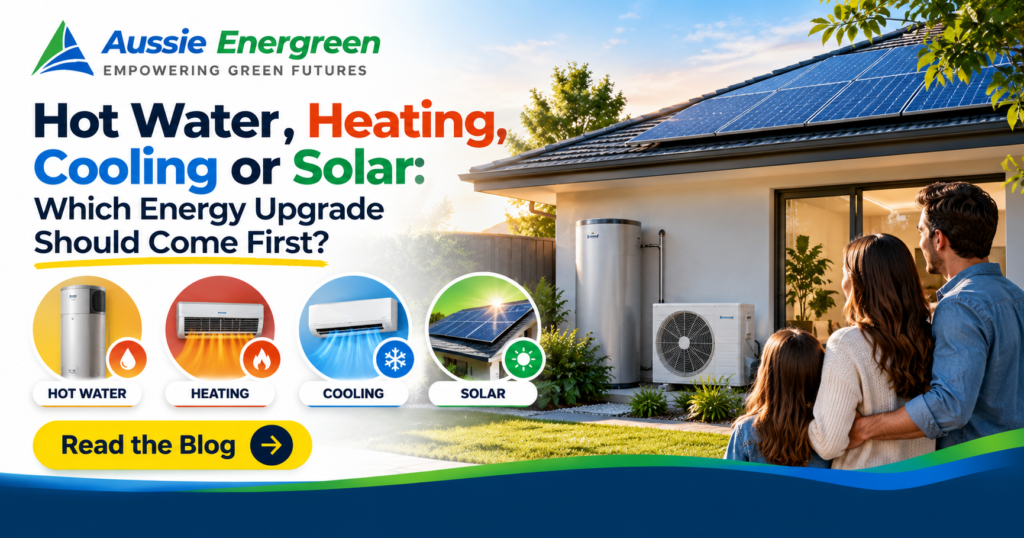
Choosing the right energy upgrade for your home can make a difference to comfort, electricity usage and long-term household expenses. For Victorian homeowners, popular options include energy-efficient hot water systems, heating and cooling upgrades, and rooftop solar. But with several choices available, how do you decide which upgrade should come first?
The answer depends on your current equipment, household energy consumption, budget, comfort needs and eligibility for available government incentives.
At Aussie Energreen, a VEU Accredited Provider, we help Victorian households explore energy upgrade options and understand which solutions may suit their homes. This guide explains the main upgrades, their benefits and how to prioritise them.
Why Should You Prioritise Energy Upgrades?
Not every home needs the same improvements. A household with an ageing hot water system may benefit from replacing it before investing in solar, while a home with high daytime electricity consumption may benefit from solar panels.
Prioritising upgrades can help you:
- Address inefficient or unreliable equipment.
- Improve year-round comfort.
- Manage electricity and hot water expenses.
- Reduce reliance on grid electricity where suitable.
- Explore applicable rebates and incentives.
- Plan improvements according to your budget.
The best starting point is to understand where your household uses the most energy and which existing systems need attention.
1. Hot Water Upgrades: A Practical Starting Point
Hot water is an important part of everyday household energy consumption. Showers, laundry, dishwashing and other daily activities all contribute to hot water demand.
If your existing electric storage hot water system is old, inefficient or frequently requires repairs, upgrading it may be worth considering.
Why consider a hot water upgrade?
A modern, energy-efficient hot water system can help improve performance and may reduce the energy required to heat water, depending on the system it replaces and how it is used.
Options include:
- Heat pump hot water systems: These use heat from the surrounding air to heat water and can be an energy-efficient alternative to conventional electric resistance systems.
- Solar hot water systems: These use solar energy to heat water, often with supplementary heating when required.
- Efficient electric systems: These may suit households where a heat pump or solar hot water system is not practical.
When should hot water come first?
Consider prioritising this upgrade if your current system is failing, has reached the end of its useful life, struggles to meet household demand or consumes significant electricity.
Before choosing a replacement, consider household size, available installation space, climate, noise requirements, tariffs and the system’s upfront cost.
2. Heating Upgrades: Improve Winter Comfort
Heating is particularly important during Victoria’s colder months. An outdated heating system may struggle to maintain a comfortable temperature or use more energy than a suitable modern alternative.
Reverse-cycle air conditioning is one option worth considering because it can provide both heating and cooling.
Benefits of upgrading your heating system
Depending on the existing equipment and replacement system, an upgrade may offer:
- More consistent indoor temperatures.
- Improved heating efficiency.
- Better control over room temperatures.
- Heating and cooling from one system when using reverse-cycle technology.
- Potential reductions in energy consumption.
When should heating come first?
Heating may be your priority if your current system is unreliable, your home is difficult to keep warm or your winter energy usage is particularly high.
You should also consider insulation, draught sealing and other building improvements. A more efficient heating system will perform better when heat loss is managed appropriately.
3. Cooling Upgrades: Prepare for Melbourne’s Summer
Victorian summers can bring periods of high temperatures, making effective cooling important for household comfort.
If your existing air conditioner is noisy, unreliable, poorly sized or expensive to operate, a suitable replacement may be worth investigating.
Which cooling system should you choose?
The right system depends on the size and layout of your home, the number of rooms you want to cool and your budget.
Common options include:
- Split-system air conditioning: Suitable for heating and cooling individual rooms or selected living areas.
- Multi-head split systems: Allow multiple indoor units to connect to one outdoor unit, subject to system design and capacity.
- Ducted air conditioning: Provides heating and cooling to multiple areas through a network of ducts.
When should cooling come first?
Prioritise cooling if your current system cannot comfortably manage summer temperatures, requires frequent repairs or does not suit your home’s layout.
Correct sizing, installation quality, insulation and sensible temperature settings all influence system performance.
If you are replacing an existing air conditioner, check whether your circumstances and the proposed equipment qualify for any applicable Victorian Energy Upgrades (VEU) incentives.
4. Solar Panels: Generate Electricity at Home
Solar panels allow households to generate electricity from sunlight. Depending on your consumption patterns, system size and electricity plan, solar can help reduce the amount of electricity purchased from the grid.
Why consider rooftop solar?
Potential benefits include:
- Generating electricity during daylight hours.
- Using solar power directly for household appliances.
- Supporting daytime operation of compatible heating, cooling and hot water equipment.
- Reducing grid electricity purchases when generation matches household demand.
- Potentially exporting surplus electricity for a retailer’s feed-in credit.
Actual benefits vary with system design, weather, shading, household consumption and electricity tariffs.
When should solar come first?
Solar may be a strong candidate if your roof is suitable, your household uses substantial electricity during daylight hours and your current energy costs justify investigating the investment.
Before installing a system, review your electricity bills, roof orientation, shading, available roof space and expected daytime usage.
You should also compare the value of using solar electricity at home with the feed-in tariff available for exported electricity.
5. Should You Add a Solar Battery?
A solar battery stores electricity for use later, such as during the evening or at night. It may be worth considering if you already have solar panels and want to use more of the electricity your system generates.
However, a battery is a separate investment and is not automatically the best first upgrade for every household.
Consider your current solar system, evening electricity usage, battery price, electricity tariff, expected usable capacity and applicable incentives before making a decision.
For some households, installing solar panels first and reviewing actual consumption before adding a battery may be a more practical approach.
Which Energy Upgrade Should Come First?
There is no universal answer. Use the following guide to identify the most relevant starting point for your home.
| Your household situation | Upgrade to investigate first |
|---|---|
| Your hot water system is failing or inefficient | Heat pump or another suitable efficient hot water system |
| Your home is difficult to heat in winter | Heating system and home insulation improvements |
| Your home becomes uncomfortably hot in summer | Suitable cooling or reverse-cycle air conditioning |
| You use significant electricity during daylight hours | Rooftop solar panels |
| You already have solar but use substantial grid electricity at night | Review battery suitability and electricity tariffs |
| Your equipment is ageing and your budget is limited | Prioritise urgent failures and the largest practical efficiency opportunity |
This table is a starting point rather than a guaranteed ranking. Installation costs, equipment condition, energy usage and eligibility can change which option makes the most sense.
Can Victorian Rebates Help With Energy Upgrades?
Eligible Victorian households may be able to access support through the Victorian Energy Upgrades (VEU) program for certain approved energy-saving activities.
A VEU incentive may reduce the upfront cost of an eligible upgrade, but availability and the amount of assistance depend on the activity, equipment, property circumstances and current program requirements.
Not every solar installation, hot water replacement or heating and cooling upgrade automatically qualifies for a VEU incentive. Other government programs may have separate eligibility rules.
As a VEU Accredited Provider, Aussie Energreen can help you understand the relevant upgrade options and check what eligibility requirements may apply to your proposed installation.
Before proceeding, ask for a clear explanation of the eligible activity, equipment specifications, any required customer contribution, installation costs and applicable terms.
A Simple Strategy for Planning Multiple Upgrades
If you are considering several improvements, a staged approach can help you make informed decisions.
Step 1: Review your energy bills
Compare electricity usage across different seasons. Look for high winter heating costs, summer cooling demand and regular hot water consumption.
Step 2: Assess your existing equipment
Identify systems that are old, unreliable, inefficient or no longer suitable for your household.
Step 3: Address urgent needs first
A failed hot water system or inadequate heating may require more immediate attention than an optional upgrade.
Step 4: Compare suitable solutions
Request quotes that explain equipment capacity, installation requirements, warranty coverage and estimated operating costs. Avoid relying solely on the lowest upfront price.
Step 5: Check current incentives
Confirm whether the proposed equipment and installation qualify for relevant programs before assuming a rebate will apply.
Step 6: Plan future improvements
Once your immediate priorities are addressed, consider complementary upgrades such as solar panels, smart controls or battery storage.
Why Choose Aussie Energreen?
Aussie Energreen supports Victorian households exploring practical energy-efficiency improvements.
As a VEU Accredited Provider, Aussie Energreen can help customers understand relevant upgrade options and applicable program requirements.
Our energy upgrade solutions include:
- Heat pump hot water systems.
- Split-system and multi-head air conditioning.
- Ducted heating and cooling solutions.
- Solar energy solutions.
- Guidance on relevant upgrade incentives and eligibility.
Every home is different. Our aim is to help you explore suitable options based on your property’s needs, existing equipment and budget.
Frequently Asked Questions (FAQs)
1. Which energy upgrade should I install first?
Start with your most urgent problem and the system offering the strongest practical opportunity for improvement. A failing hot water system, inefficient heating or high daytime electricity consumption may point towards different priorities.
2. Is a heat pump hot water system better than a conventional electric system?
A heat pump can use less electricity than a conventional electric resistance storage system because it transfers heat from the surrounding air. However, performance and suitability depend on the model, installation location, climate, hot water demand and operating conditions.
3. Should I install solar panels before upgrading my air conditioner?
It depends on your current system and electricity usage. Solar may be attractive if you consume significant electricity during daylight hours. However, an unreliable or inefficient air conditioner may need attention first. You should compare both options using your household’s actual needs and budget.
4. Can solar panels run my air conditioner?
Solar panels can supply electricity to a compatible air conditioning system while generating sufficient power. Actual performance depends on solar output, weather, system capacity and the home’s other electricity loads. Grid electricity may still be required when solar generation is insufficient.
5. Are rebates available for hot water and air conditioning upgrades in Victoria?
Some eligible upgrades may receive support under the VEU program or other applicable schemes. Eligibility depends on current program rules, equipment specifications, the property and the installation. Confirm eligibility before committing to an upgrade.
6. Is Aussie Energreen a VEU Accredited Provider?
Yes. Aussie Energreen is a VEU Accredited Provider. Customers should still confirm whether their specific upgrade qualifies for an incentive and review all applicable terms and costs.
7. Do I need a solar battery if I already have solar panels?
Not necessarily. A battery may help store surplus solar electricity for later use, but its financial suitability depends on your usage patterns, electricity tariffs, installation cost and available incentives.
8. Can I upgrade hot water, heating, cooling and solar together?
Yes, multiple upgrades can be planned as part of a broader home energy improvement strategy. They do not all need to be installed at once. A staged plan can help you manage costs and prioritise your household’s most important needs.
9. How do I get started with Aussie Energreen?
Contact Aussie Energreen to discuss your existing equipment, energy upgrade goals and the options that may suit your Victorian home.
Summary
Choosing between hot water, heating, cooling and solar upgrades starts with understanding your household’s needs.
- Hot water: Investigate an efficient replacement if your existing system is ageing, unreliable or energy-intensive.
- Heating: Prioritise comfort and efficiency if your home is difficult to heat.
- Cooling: Consider an appropriately sized system if summer comfort is a concern.
- Solar: Explore rooftop solar if your roof and electricity usage make it a suitable investment.
- Battery storage: Consider it separately after reviewing your solar generation, evening usage and electricity costs.
There is no single upgrade that is right for every household. By reviewing your energy bills, assessing your existing equipment and checking available incentives, you can make a more informed decision about where to start.
Aussie Energreen is a VEU Accredited Provider, helping Victorian households explore energy upgrade solutions for greater comfort and energy efficiency.
Contact Aussie Energreen
Ready to explore your next energy upgrade? Speak with our team to discuss suitable solutions for your home.
Aussie Energreen — Empowering Green Futures
- Phone: 1300 231 289
- Email: info@aussieenergreen.com.au
- Website: https://aussieenergreen.com.au/
Rebate availability and eligibility can change. Confirm current program requirements, equipment eligibility, customer contributions and installation costs before proceeding.