
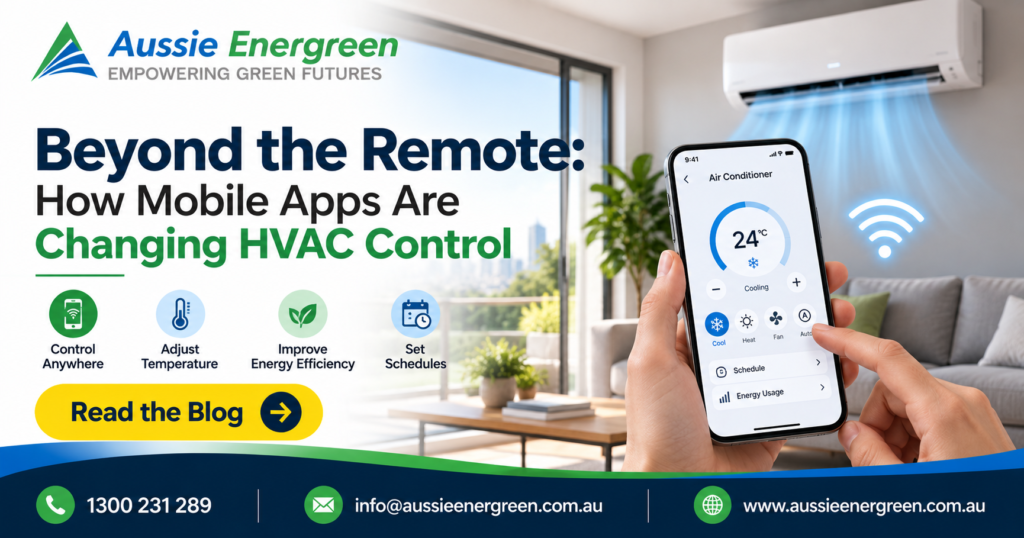
Imagine adjusting your home’s air conditioning before arriving home, changing the temperature from your smartphone, or setting an operating schedule without searching for a remote control.
Modern HVAC technology is making these possibilities increasingly accessible. With compatible equipment and mobile applications, users can manage various heating and cooling functions directly from their smartphones.
Traditional remote controls remain useful for everyday operation, but connected HVAC systems offer additional flexibility. Depending on the equipment, mobile apps may allow users to adjust temperatures, select operating modes, create schedules and check system status from a convenient interface.
For homeowners and businesses, these features can make managing indoor comfort easier. They can also support more thoughtful energy use when configured appropriately.
In this guide, Aussie Energreen explores how mobile apps are transforming HVAC control, the features to consider and what to check before choosing a connected air conditioning system.
1. From Traditional Remotes to Smart HVAC Control
For many years, physical remote controls have been the standard way to operate residential air conditioners. They provide convenient access to basic functions, including temperature adjustment, fan speed and operating modes.
Mobile applications extend these capabilities by allowing compatible HVAC equipment to be controlled through a smartphone or tablet.
| Feature | Traditional Remote Control | Mobile App Control |
|---|---|---|
| Temperature adjustment | Available | Available on compatible systems |
| Operating modes | Basic mode selection | Additional controls may be available |
| Remote access | Usually within the unit’s operating range | Internet-based control may be supported |
| Scheduling | Available on some models | Flexible scheduling may be available |
| System information | Usually limited | Status updates and notifications may be supported |
| Multiple units | Depends on the remote and equipment | Multiple compatible devices may be manageable |
The available functions vary according to the HVAC model, control hardware, application and network configuration. Some systems have built-in connectivity, while others require an additional Wi-Fi module or gateway.
The main advantage is flexibility: users may have more options for controlling their heating and cooling without relying entirely on a physical remote.
2. Five Ways Mobile Apps Are Changing HVAC Management
Control Your Air Conditioner Remotely
One of the most convenient features of connected HVAC equipment is the ability to adjust settings without being physically near the indoor unit.
For example, you may be able to switch on cooling before arriving home or change a temperature setting while away.
These functions generally require compatible equipment, the correct app configuration and a reliable internet connection. Remote access should be confirmed before purchasing a system, as not every air conditioner supports it.
Create Schedules Around Your Daily Routine
Many households and businesses follow predictable daily patterns. Mobile HVAC apps may allow users to create schedules that reflect when a property is occupied.
For example, a homeowner could arrange for the air conditioner to operate around their usual arrival time. A small office might schedule heating or cooling to align with its normal business hours.
Appropriate scheduling may help reduce unnecessary operation when a space is unoccupied. However, actual energy savings depend on the building, weather, system settings and usage patterns.
Personalise Indoor Comfort
Different people have different comfort preferences, and these can change throughout the day.
Depending on the system, an app may provide access to temperature settings, fan speeds, cooling and heating modes, and other available functions.
Having these controls in one interface can make it easier to adjust indoor conditions without locating a traditional remote.
For homes with multiple compatible units, app-based management may also simplify everyday adjustments across different rooms.
Check Operating Status More Easily
Some connected HVAC systems provide information about their current operating mode, temperature setting or equipment notifications.
This visibility can help users understand how their systems are operating and identify when a setting needs adjustment.
However, app-based status information is not necessarily equivalent to professional diagnostics. Detailed fault identification and repair functions depend on the equipment and the manufacturer’s support capabilities.
Manage Compatible Devices From One Interface
For households and businesses with several air conditioning units, a compatible application may provide a central place to access multiple devices.
Depending on the system, users may be able to manage individual units, adjust settings or create separate schedules.
This can be particularly useful in multi-room homes, small offices and retail premises. Before choosing a system, check the number of devices supported and whether the application offers the control functions you require.
3. Can Smart HVAC Apps Help Improve Energy Efficiency?
Mobile applications can help users manage heating and cooling more deliberately, but installing an app does not automatically make an air conditioner more energy-efficient.
The potential benefit comes from how the available controls are used.
For example, schedules can help prevent equipment from running unnecessarily during certain unoccupied periods. Convenient smartphone access may also make it easier to adjust settings when household or business routines change.
Several other factors continue to influence energy consumption:
- System efficiency: The performance and energy rating of the air conditioning equipment.
- Correct sizing: Whether the system is appropriately sized for the property and its heating or cooling requirements.
- Building insulation: How effectively the building retains conditioned air.
- Temperature settings: The temperatures selected and how frequently they are changed.
- Operating schedules: How long the system runs and whether operation matches occupancy.
- Installation and maintenance: Whether the equipment is correctly installed and properly maintained.
Smart controls work best when they support sensible operating habits and are paired with suitable equipment.
4. What to Check Before Choosing an App-Controlled HVAC System
If you are planning an air conditioning upgrade, it is worth checking the available control features before making a purchase.
Confirm Compatibility
Check whether the air conditioner supports mobile app control as standard or requires an optional Wi-Fi adapter, communication module or gateway.
Do not assume that every model within the same product range offers identical connectivity features.
Understand the Connectivity Requirements
Find out whether the system needs a Wi-Fi connection, internet access or a specific network configuration.
Also confirm whether local control remains available if the internet connection is interrupted.
Review the Available Functions
Compare the features offered by the app, including:
- Temperature and operating mode adjustments
- Fan speed control
- Scheduling and timers
- System status information
- Notifications, where supported
- Management of multiple compatible units
The exact list will depend on the model and software.
Check Multi-User and Multi-Device Support
If several family members or employees need access, check whether the app supports multiple users and the required permissions.
For properties with several air conditioners, confirm whether all the units can be managed through the same application.
Consider Security and Ongoing Support
Connected equipment relies on software and account access, so security and long-term support matter.
Look for information about account protection, software updates, privacy practices and the availability of technical assistance. Check whether the manufacturer continues to support the app and compatible equipment.
Taking these steps can help you choose a system that meets your expectations for both comfort and usability.
5. Where Can Mobile HVAC Control Be Useful?
App-based controls can support different types of properties, depending on the equipment installed.
| Property Type | Potential Benefits |
|---|---|
| Residential homes | Adjust settings remotely and create schedules around household routines |
| Small offices | Align heating and cooling with normal working hours |
| Retail stores | Coordinate operation with opening and closing times |
| Multi-room properties | Manage compatible units or zones where supported |
| Rental and investment properties | Convenient operation where the equipment, access arrangements and app permissions allow it |
For larger commercial buildings, a consumer HVAC app may not provide the advanced monitoring and coordination available through a Building Management System (BMS).
The right solution depends on the property’s size, the equipment involved and the level of control required.
6. What Does the Future Hold for Connected HVAC Control?
HVAC technology is continuing to evolve, with connectivity becoming an important consideration alongside system performance, installation and maintenance.
Future developments may include closer integration with smart home platforms, more detailed energy monitoring and additional automation options on compatible equipment.
For homeowners, these developments could offer more convenient ways to manage indoor comfort. For contractors and businesses, they highlight the importance of understanding connectivity requirements and software support when selecting equipment.
However, more technology is not always necessary for every application. A straightforward remote control may be sufficient for some households, while others may benefit from app-based access and scheduling.
The objective is to choose a control solution that suits the property, its occupants and their everyday requirements.
Conclusion: HVAC Control Is About More Than the Remote
Traditional remote controls remain a practical way to operate air conditioning systems. Mobile apps build on this familiar approach by providing additional ways to manage temperatures, schedules and compatible equipment.
When used appropriately, connected controls can make heating and cooling more convenient and help households and businesses manage operation around their daily routines.
Before choosing an app-enabled system, check its compatibility, connectivity requirements, available features and ongoing support. These details are just as important as selecting the right air conditioning capacity and efficiency rating.
At Aussie Energreen, we help customers explore heating and cooling solutions suited to their properties and requirements.
Ready to explore your air conditioning options? Contact Aussie Energreen Accredited Provider to discuss a suitable solution for your home or business.
Frequently Asked Questions Mobile Apps Are Changing HVAC Control
1. Can I control my air conditioner using my smartphone?
Yes, if your air conditioning system supports mobile app control. Some models include built-in connectivity, while others require an additional Wi-Fi module or compatible control device.
2. Can I turn on my air conditioner before arriving home?
Some compatible systems support internet-based remote access, allowing users to adjust settings while away. This generally requires the correct app setup, compatible equipment and an active internet connection.
3. Do HVAC mobile apps reduce electricity bills?
They may help users manage operating schedules and avoid unnecessary heating or cooling. However, savings are not guaranteed and depend on equipment efficiency, temperature settings, occupancy, building conditions and energy usage.
4. Can one app control multiple air conditioning units?
Some applications support multiple compatible units, but the number of devices and available functions vary. Confirm compatibility and device limits with the manufacturer before purchasing.
5. Do I need Wi-Fi to use an HVAC mobile app?
Requirements vary by system. Remote control over the internet generally requires network connectivity, while some systems may offer limited local control. Check the manufacturer’s specifications for the exact model.
6. Is mobile app control better than a traditional remote?
Neither option is automatically better for everyone. A physical remote is straightforward for nearby adjustments, while a mobile app may provide remote access, scheduling and additional features on compatible systems.
7. What should I consider before buying an app-controlled air conditioner?
Check app compatibility, connectivity requirements, available control functions, multi-device support, security features, software updates and ongoing manufacturer support. Also consider the system’s capacity, efficiency and suitability for your property.
Summary: Key Takeaways Mobile Apps Are Changing HVAC Control
- Mobile apps can extend HVAC control beyond the traditional physical remote.
- Compatible systems may support remote adjustments, scheduling and operating-status information.
- Smart controls can support better energy management, but they do not guarantee lower bills.
- Connectivity, device compatibility, security and ongoing software support should be checked before purchase.
- The most suitable HVAC solution depends on the property’s heating and cooling requirements.
Contact Aussie Energreen Mobile Apps Are Changing HVAC Control
Looking for an air conditioning solution for your home or business? Get in touch with Aussie Energreen to discuss your requirements.
- Phone: 1300 231 289
- Email: info@aussieenergreen.com.au
- Website: https://aussieenergreen.com.au/
Aussie Energreen — Empowering Green Futures.