
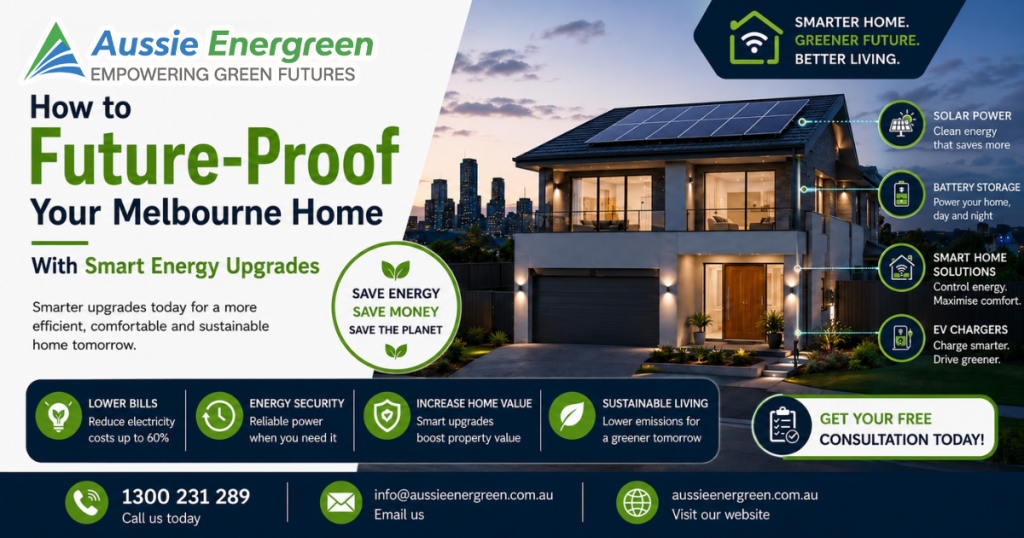
As energy prices, household electricity demand and the need for efficient living continue to change, Melbourne homeowners are looking for smarter ways to manage their energy.
Future-proofing your home doesn’t necessarily mean making one major upgrade. Instead, it can involve combining practical energy-efficient technologies such as solar panels, battery storage, efficient hot water, smart energy management and EV charging.
At Aussie Energreen, we help Melbourne homeowners choose energy solutions designed around their current needs while allowing room for future upgrades.
What Does It Mean to Future-Proof Your Home?
A future-ready home is designed to use energy more efficiently, generate more of its own electricity and make better use of available technology.
Rather than relying entirely on electricity from the grid, homeowners can consider a combination of:
- ☀️ Solar panels
- 🔋 Solar battery storage
- 🌡️ Heat pump hot water systems
- ⚡ Energy-efficient appliances
- 🚗 EV charging
- 💡 Smart energy management
- ❄️ Efficient heating and cooling
The right combination depends on your home’s energy consumption, budget, property and future plans.
1. Install Solar Panels
Solar panels are one of the most practical ways to improve household energy efficiency.
They convert sunlight into electricity that can be used to power your home during the day. Any excess electricity may be exported to the grid or, where a battery is installed, stored for later use.
Benefits of solar include:
- Reduced reliance on grid electricity
- Potentially lower electricity bills
- Renewable energy generation
- Better control over daytime energy costs
- Reduced household emissions
The ideal solar system size depends on your electricity consumption, roof space, shading, orientation and future energy requirements.
2. Add Battery Storage
Solar panels generate electricity during daylight hours, but many households use significant amounts of energy in the evening.
A solar battery can help bridge this gap.
During the day, excess solar electricity can be stored in the battery. When solar generation falls, stored electricity can be used to help power your home.
Battery storage can help you:
- Use more of your own solar energy
- Reduce evening grid consumption
- Increase energy independence
- Make better use of excess solar generation
- Potentially prepare your home for future electricity demand
If you already have solar, adding a battery may also be an option, depending on your existing system and equipment.
3. Upgrade Your Hot Water System
Hot water can represent a significant part of household energy consumption.
Traditional electric hot water systems can consume substantial amounts of electricity, particularly when operated during expensive periods.
A heat pump hot water system uses heat from the surrounding air to heat water and can be considerably more energy efficient than conventional electric systems.
For homes with solar panels, operating a compatible heat pump during periods of strong solar generation can also help make better use of your home’s solar electricity.
4. Make Heating and Cooling More Efficient
Heating and cooling can have a major impact on household electricity consumption, particularly during Melbourne’s hot summers and cold winters.
An efficient reverse-cycle air conditioning or ducted system can provide both heating and cooling while giving homeowners greater control over indoor temperatures.
Smart heating and cooling strategies include:
- Choosing appropriately sized systems
- Using zoning where suitable
- Improving insulation
- Setting efficient temperature levels
- Using timers and smart controls
- Running energy-intensive equipment when solar generation is available
A properly designed system can help improve comfort without unnecessarily increasing energy consumption.
5. Prepare for an Electric Vehicle
Electric vehicles are becoming increasingly common in Australian households.
If you’re considering an EV now or in the future, it’s worth thinking about how your home’s energy system will support charging.
Solar panels can potentially provide electricity for daytime EV charging, while battery storage can provide another source of stored energy depending on the system configuration.
A future-ready home can therefore be designed with solar generation, battery storage and EV charging in mind from the beginning.
6. Consider Smart Energy Management
Generating and storing electricity is only part of the solution.
Knowing when and how your home uses energy can also make a significant difference.
Smart energy technologies can help homeowners monitor electricity consumption and better understand where energy is being used.
Depending on the equipment installed, homeowners may be able to monitor:
- Solar generation
- Household consumption
- Battery charge levels
- Grid electricity usage
- Energy exports
- EV charging
This information can help you make more informed decisions about your energy use.
7. Upgrade Inefficient Appliances
Future-proofing your home isn’t only about installing new energy technology.
Replacing older, inefficient appliances can also reduce electricity consumption.
When upgrading appliances, consider their:
- Energy efficiency
- Running costs
- Usage patterns
- Expected lifespan
- Compatibility with your solar system
Prioritising appliances that consume significant amounts of electricity can often have a greater impact than replacing equipment that uses very little energy.
8. Plan Your Energy System Around Your Lifestyle
Every home is different.
A household that uses most of its electricity during the day may have different requirements from a family that consumes most of its energy after work and school.
For example:
A daytime-use household
Solar panels may provide significant value because electricity is consumed while the panels are generating.
A high evening-use household
Solar panels combined with battery storage may help shift some daytime solar energy into the evening.
A future EV owner
Solar, battery storage and EV charging can be considered together when planning the home’s energy system.
A household with high hot-water consumption
Solar generation combined with an efficient heat pump hot water system may help reduce energy costs.
9. Think About Future Energy Demand
Your home’s electricity requirements may change over the next five to ten years.
You may eventually add:
- An electric vehicle
- Battery storage
- Heat pump hot water
- Additional air conditioning
- A pool
- A home office
- More appliances
- A larger household
When installing solar or upgrading your electrical infrastructure, considering future requirements can help avoid unnecessary upgrades later.
10. Consider Available Government Incentives
Government incentives and energy-efficiency programs can change over time.
Depending on the technology, location and eligibility requirements, Victorian households may have access to different rebates, discounts or certificate-based incentives.
Eligibility and incentive values should always be checked before making a purchasing decision, as programs can change.
Aussie Energreen can help you understand which energy solutions may be suitable for your home and whether applicable incentives should be considered when preparing your upgrade plan.
Why Choose Aussie Energreen?
At Aussie Energreen, we believe energy upgrades should be planned around the homeowner rather than simply selling individual products.
Our team can help Melbourne homeowners explore solutions including:
- Solar panel systems
- Solar battery storage
- Heat pump hot water
- Reverse-cycle air conditioning
- Ducted air conditioning
- EV charging solutions
- Energy-efficient upgrades
- Smart energy solutions
We can assess your energy requirements and help you build a practical upgrade pathway that can evolve as your household’s needs change.
Smart Energy Upgrades for Melbourne Homes
Future-proofing doesn’t mean you need to install everything at once.
You could start with solar panels and later add battery storage. You might upgrade your hot water system first and install an EV charger when you purchase an electric vehicle.
The important thing is to plan your upgrades as part of one overall energy strategy.
This approach can help you avoid incompatible equipment, unnecessary costs and repeated electrical work.
Summary Smart Energy Upgrades
Future-proofing your Melbourne home is about making smarter decisions today that can support your energy needs tomorrow.
Solar panels can generate renewable electricity, battery storage can store excess energy, heat pump hot water can improve hot-water efficiency, and smart energy technologies can help you understand and manage your consumption.
If you’re planning an EV, upgrading your heating and cooling or simply looking for ways to reduce your home’s energy costs, it can be worthwhile to look at your energy system as a whole.
Aussie Energreen can help you plan practical, energy-efficient upgrades for your Melbourne home.
Frequently Asked Questions Smart Energy Upgrades
What is the best way to future-proof my home?
There isn’t one solution for every home. A combination of solar, battery storage, efficient hot water, heating and cooling, smart energy management and EV charging may be suitable depending on your energy usage and future plans.
Should I install solar panels before a battery?
Many homeowners start with solar panels and add a battery later. However, installing both together can also make sense depending on your budget and energy requirements.
Is a solar battery worth it if I already have solar?
It can be, particularly if your home exports substantial solar electricity during the day and uses significant electricity after sunset. A review of your energy consumption can help determine whether storage is suitable.
Can solar power be used to charge an EV?
Yes. Solar electricity can be used to charge an EV when the vehicle is connected to a compatible charging system. Smart charging can help make better use of available solar generation.
Are heat pump hot water systems energy efficient?
Heat pump hot water systems are generally much more energy efficient than conventional electric-resistance hot water systems because they transfer heat from the surrounding air rather than generating heat directly.
Can I add a battery to my existing solar system?
In many cases, yes. Compatibility depends on your existing solar panels, inverter, switchboard and the battery system selected.
Do I need a smart energy management system?
Not every home needs one, but monitoring and smart controls can be useful for households with solar, batteries, EVs or multiple high-energy appliances.
Are there rebates available for energy upgrades in Victoria?
Some government programs and incentives may be available depending on the technology and eligibility criteria. Programs can change, so always check the current requirements before committing to an installation.
Get Started With Aussie Energreen Smart Energy Upgrades
Ready to make your Melbourne home more energy efficient and future-ready?
Contact Aussie Energreen for expert advice and a tailored energy solution.
📞 1300 231 289
📧 info@aussieenergreen.com.au
🌐 aussieenergreen.com.au
Aussie Energreen — Empowering Green Futures.