
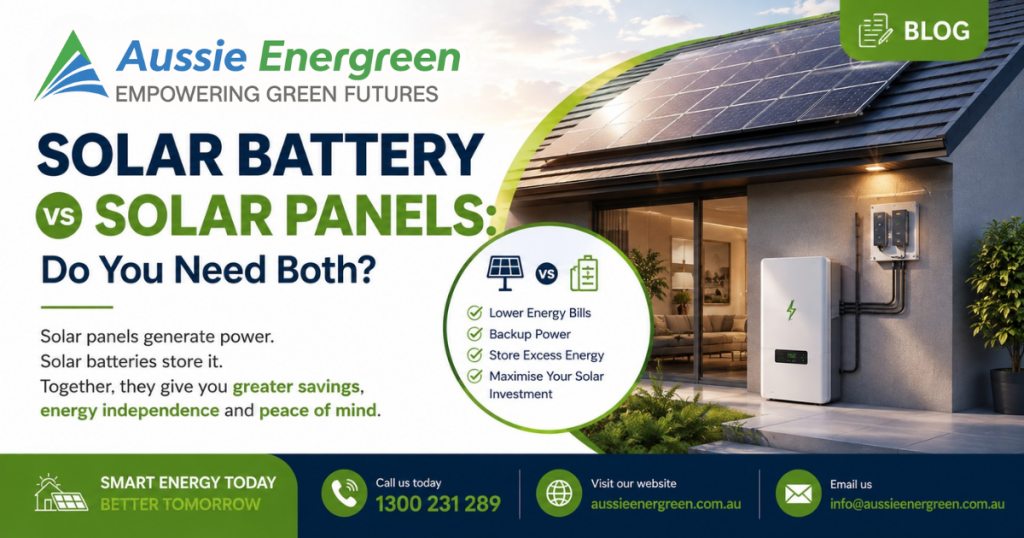
Solar panels and solar batteries are two of the most popular technologies for improving household energy efficiency. While they work together, they serve very different purposes.
Solar panels generate electricity from sunlight, while a solar battery stores excess electricity so you can use it later.
For many Australian households, combining both technologies can help increase solar self-consumption, reduce reliance on grid electricity and provide greater control over energy usage.
At Aussie Energreen, we help homeowners understand whether solar panels, a battery, or a combination of both is the right solution for their property and energy needs.
Solar Panels vs Solar Batteries: What’s the Difference?
The simplest way to understand the difference is:
Solar panels generate energy.
Solar batteries store energy.
During the day, your solar panels generate electricity. Your home uses that electricity first. If your solar system produces more energy than your home needs, the excess can either be exported to the grid or stored in a battery if you have one.
Without a battery, much of your excess solar generation may be exported to the electricity grid.
With a battery, you can store some of that excess energy and use it later.
How Do Solar Panels Work?
Solar panels convert sunlight into electricity using photovoltaic cells.
During daylight hours, the panels generate electricity that can be used to power appliances such as:
- Air conditioning
- Refrigerators
- Washing machines
- Hot water systems
- Lighting
- Pool pumps
- Home office equipment
- EV chargers
The amount of electricity generated depends on factors such as system size, weather, roof orientation, shading and time of day.
The main benefit of solar panels
Solar panels can reduce the amount of electricity your household needs to purchase from the grid.
However, solar generation is highest during daylight hours, while many households use significant amounts of electricity in the evening.
That’s where a battery can become useful.
How Does a Solar Battery Work?
A solar battery stores electricity for later use.
For example:
Daytime:
Solar panels generate electricity → Home uses what it needs → Excess energy charges the battery.
Evening:
Solar production decreases → Battery supplies stored electricity to the home.
This allows you to use more of the electricity your solar panels generated instead of purchasing as much electricity from the grid later.
Do You Need Both Solar Panels and a Battery?
Not necessarily.
The right solution depends on your electricity usage, existing solar system, electricity tariff, budget and energy goals.
Solar Panels Only May Be Suitable If:
- Your electricity consumption is mainly during the day
- You have limited evening energy usage
- You want to reduce your upfront investment
- You are primarily looking to reduce daytime grid consumption
- You are happy to export excess solar electricity
Solar Panels + Battery May Be Better If:
- You use a lot of electricity in the evening
- Your home exports significant amounts of solar energy
- You want to increase solar self-consumption
- You want greater energy independence
- You are interested in backup power, where supported
- You want to make better use of your existing solar investment
Why Combine Solar Panels With a Battery?
Combining the two technologies creates a more complete home energy system.
1. Use More of Your Own Solar Energy
Without storage, excess electricity generated during the day may be exported to the grid.
A battery gives you the option of storing some of that energy for later.
2. Reduce Evening Grid Consumption
Solar panels generally don’t produce electricity after sunset.
A battery can provide stored energy during the evening, potentially reducing the amount of electricity you purchase from the grid.
3. Improve Energy Independence
A solar-plus-battery system can reduce your dependence on grid electricity.
The level of energy independence you achieve depends on your system size, battery capacity and household consumption.
4. Potential Backup Power
Some battery systems can provide backup power during a grid outage.
However, not every solar battery automatically provides whole-home backup.
If backup power is important to you, your installer should design the system specifically for that purpose and explain which circuits can remain powered during an outage.
5. Make Better Use of Your Solar Investment
If your household regularly produces more solar electricity than it can use during the day, adding storage can provide another way to use that energy later.
What If You Already Have Solar Panels?
You don’t necessarily need to replace your existing solar system to add a battery.
Depending on your existing equipment, a battery can potentially be added to an existing solar installation.
The best approach depends on:
- Existing inverter
- Solar system size
- System age
- Battery compatibility
- Available switchboard capacity
- Household electricity usage
- Backup requirements
An installer should assess your existing system before recommending a battery.
How Big Should Your Solar Battery Be?
Battery size is measured in kilowatt-hours (kWh).
For example, a 10 kWh battery can provide a certain amount of usable stored energy, depending on the battery’s usable capacity and operating conditions.
But choosing the biggest battery available isn’t always the best option.
Your battery should be matched to your actual energy consumption.
A professional assessment should consider:
- Daily electricity consumption
- Evening electricity usage
- Existing solar generation
- Solar system size
- Peak electricity demand
- Battery usable capacity
- Future energy requirements
- EV charging
- Electric hot water
- Air conditioning usage
Aussie Energreen can help assess your energy profile and determine what battery capacity may suit your household.
Can a Battery Reduce Your Electricity Bills?
A battery can potentially reduce grid electricity purchases by allowing you to use stored solar energy when your panels aren’t generating enough electricity.
However, savings aren’t guaranteed and depend on several factors.
These include:
- Electricity prices
- Feed-in tariff
- Battery size
- Solar system size
- Household energy consumption
- Battery efficiency
- Installation cost
- How the battery is operated
This is why a battery should be selected based on your actual electricity usage, rather than simply choosing a battery based on its advertised capacity.
Solar Battery vs Solar Panels: Which Should You Install First?
If you don’t currently have solar, installing solar panels first is often the starting point.
Solar panels generate the electricity.
A battery then gives you the ability to store excess generation for later use.
However, some homeowners may choose a combined solar-and-battery installation from the beginning.
The right choice depends on your budget, energy usage and long-term plans.
What About Government Rebates and Incentives?
Government incentives can change over time, and eligibility depends on the system, property and applicable scheme.
Depending on your location and circumstances, you may be able to access incentives for eligible solar or battery installations.
For example, Australia’s federal Small-scale Renewable Energy Scheme (SRES) provides incentives for eligible small-scale renewable energy systems, while the Australian Government’s Cheaper Home Batteries Program provides support for eligible small-scale battery installations through STCs.
If you’re considering a battery, it’s important to check the current incentive rules before making a purchase.
Aussie Energreen can help you understand the incentives that may apply to your proposed system.
Solar Battery and Solar Panels for Melbourne Homes
Melbourne households have different energy requirements depending on property size, household size and lifestyle.
A typical family home may use electricity for:
- Heating and cooling
- Hot water
- Kitchen appliances
- Laundry
- Lighting
- Entertainment
- Pool equipment
- EV charging
If much of your electricity use occurs after sunset, battery storage may be particularly worth investigating.
Homes with significant daytime electricity consumption may benefit strongly from solar panels even without a battery.
What Should You Consider Before Buying a Battery?
Before investing in battery storage, look at your electricity bills and understand how your household uses energy.
Check Your Electricity Consumption
Review your electricity usage over at least several months.
If interval data is available, it can provide a much clearer picture of when you consume electricity.
Look at Your Solar Exports
If you already have solar, check how much electricity you’re exporting to the grid.
Consistently high daytime exports may indicate that battery storage could be worth investigating.
Consider Your Evening Usage
Think about how much electricity your home uses after sunset.
If your household uses significant amounts of electricity at night, stored solar energy may be more valuable.
Think About Future Energy Needs
Your electricity consumption may increase if you plan to add:
- An electric vehicle
- Heat pump hot water
- More air conditioning
- A pool
- Additional appliances
Planning for future energy use can help you choose a more suitable system.
Why Choose Aussie Energreen?
At Aussie Energreen, we take a complete approach to home energy solutions.
Rather than simply recommending the largest solar system or battery, we consider your property’s energy requirements and future goals.
Our team can assist with:
- Solar panel installations
- Solar battery systems
- Battery additions to existing solar
- System sizing
- Energy assessments
- Inverter solutions
- Government incentive guidance
- Monitoring solutions
- Professional installation
Our goal is to help you make an informed decision and build an energy system that works for your home.
Frequently Asked Questions
Is a solar battery better than solar panels?
They aren’t really alternatives. Solar panels generate electricity, while batteries store electricity. They perform different functions and can work together.
Do I need a battery if I already have solar panels?
Not necessarily. If you use most of your solar electricity during the day, panels alone may work well. If you export significant amounts of solar and use lots of electricity at night, a battery may be worth considering.
Can I add a battery to my existing solar system?
In many cases, yes. Compatibility depends on your existing inverter, solar system configuration and battery technology. A professional assessment is recommended.
How long does a solar battery last?
Battery lifespan varies by technology, manufacturer, usage and operating conditions. Always compare the manufacturer’s warranty, cycle specifications and usable capacity before purchasing.
Can a solar battery work during a blackout?
Some battery systems can provide backup power, but backup capability depends on the battery, inverter and system configuration. A suitable backup setup needs to be specifically designed and installed.
What size battery do I need?
There is no single battery size that suits every household. Your ideal capacity depends on your electricity consumption, solar generation and evening energy usage.
Can solar panels charge a battery?
Yes. Solar panels can supply excess electricity to a compatible battery system for storage and later use.
Are solar batteries worth it in Melbourne?
They can be, particularly for households with significant evening electricity consumption or high solar exports. Your individual electricity usage and tariff should be assessed before making a decision.
Summary
Solar panels and solar batteries work together, but they aren’t the same thing.
Solar panels generate electricity during daylight hours, while batteries store energy for later use.
For some homes, solar panels alone may provide excellent value. For households with high evening electricity consumption, significant solar exports or a desire for greater energy independence, adding a battery may make sense.
The best solution depends on your energy usage, solar generation, electricity tariff, property and future plans.
If you’re unsure whether you need solar panels, a battery or both, Aussie Energreen can assess your requirements and help you choose a suitable solution.
Get Your Free Solar & Battery Quote
Ready to take control of your energy?
Contact Aussie Energreen today for a tailored solar or battery solution.
📞 1300 231 289
📧 info@aussieenergreen.com.au
🌐 aussieenergreen.com.au
Aussie Energreen — Empowering Green Futures.